Help & FAQS
Pressure Gauge FAQs
Frequently Asked QuestionsDoes liquid filling improve a gauge's accuracy?
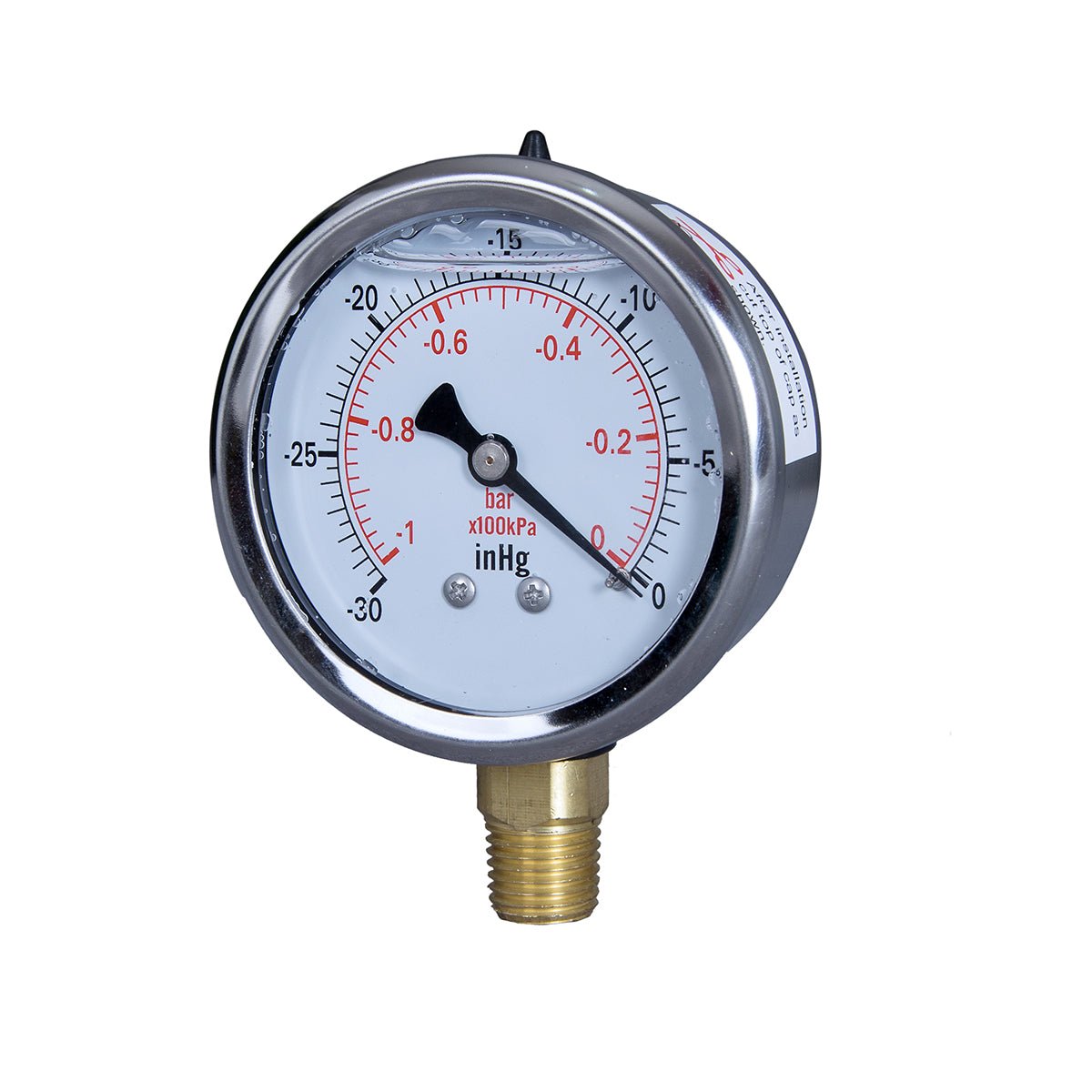
No. Fill fluid damps pointer vibration and lubricates the movement, but calibration accuracy is set by the tube and movement quality under EN 837-1 or ASME B40.100 conventions — Class 1.6 is typical for quality general-service gauges, filled or dry. A liquid filled gauge reads the same pressure as its dry equivalent; it just keeps the pointer steady enough to read and slows mechanical wear.
What temperature range can a glycerin filled gauge handle?
Glycerin fill performs in roughly -20°C to +60°C service. Below that band it thickens and pointer response turns sluggish; above it the fluid degrades faster. For freezer-adjacent or high-heat applications, specify silicone oil fill, which spans roughly -40°C to +200°C. Confirm the ambient and process temperatures at the install point before ordering volume.
Why is my liquid filled gauge fogging up?
Internal fog means moisture entered the case — usually through a compromised seal or fill plug on a gauge that wasn't completely filled at manufacture. A properly vacuum-filled, sealed gauge leaves negligible air volume, so condensation shouldn't form. Reseat the fill plug if loose; persistent fogging warrants replacement and a conversation with your supplier about fill completeness QC. Full diagnosis in our fogging troubleshooting guide referenced above.
Can I refill a gauge that lost its fill fluid?
Practically, no — refilling in the field rarely restores full performance because achieving a complete, air-free fill requires vacuum filling equipment, and any residual air undermines both damping and anti-condensation function. A gauge that visibly lost fluid should be treated as compromised and replaced, especially since the leak path admits moisture too.
What pressure range should I choose?
Keep normal operating pressure between about 25% and 75% of full scale, with steady loads capped at 75% and cyclic loads at roughly 65%. Example: a compressor cutting out at 120 psi fits a 0–200 psi gauge (60% of range). This preserves tube life on the high side and dial resolution on the low side. Our spec-sheet reading guide shows how to verify ranges against datasheets.
Are liquid filled gauges worth it on an air compressor?
Yes — reciprocating compressors are the strongest case for liquid fill. Piston strokes create pressure pulsation that renders dry gauge needles nearly unreadable and wears movements prematurely. A glycerin filled 0–200 psi dual-scale gauge with 1/4" NPT lower mount solves both problems for a modest price premium, which is why most serious compressor builders now ship filled gauges as standard.
Orders, OEM & Shipping
What is the MOQ for custom gauges?
200 pcs per design. Mixed sizes and ranges count toward the same MOQ.
Do you provide samples before mass production?
Yes, samples are available; the sample cost is refunded when you place the bulk order.
What are your delivery times?
In-stock items ship within 48 hours; custom OEM orders typically take 25-35 days.
Can you print our own brand or logo?
Yes, we support full OEM/ODM: custom dials, ranges, units, connections, and your branding.
What warranty do you offer?
12 months against manufacturing defects.
Where is JIVTO located?
We are a factory-direct manufacturer in Wenzhou, China, exporting to the US and Europe since 2011.
Still have questions? Contact our engineers for factory-direct pricing and technical support.