Best Pressure Gauge for Air Compressor: A Spec-Driven Shortlist (2026)
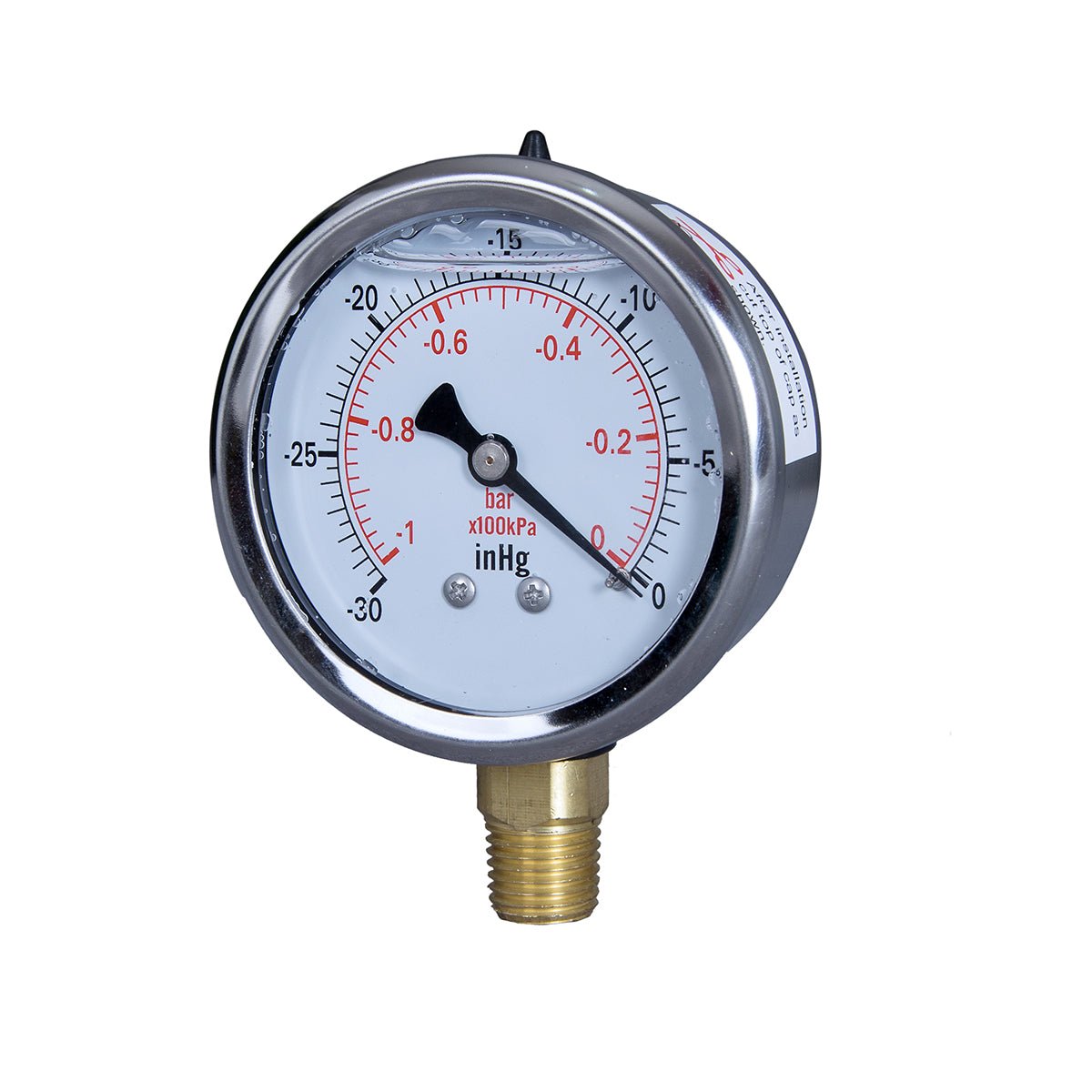
JIVTOThe best pressure gauge for most air compressors is a glycerin-filled gauge with a 0–230 or 0–300 psi dual-scale dial, a 1/4" NPT connection, and a 2"–2.5" face. That combination covers the pressure class of nearly every home and shop compressor, threads straight into the standard tank port, and — most importantly — survives the vibration that a reciprocating pump produces every time it runs. If your compressor sits on a rigid mount or runs for long stretches, a liquid filled gauge will outlast a dry economy gauge several times over, because the fill fluid damps pointer flutter and lubricates the movement while the machine shakes.
One thing up front, in the interest of honesty: JIVTO manufactures and supplies these gauges, so this is not a "we tested 50 brands" listicle. It is a spec-driven selection guide. We will give you the four criteria that actually determine whether a compressor tank gauge lasts, a shortlist of three archetypes that cover virtually every install, and the sizing math behind our recommendation — so you can verify each claim against your own compressor before buying anything.

Key Takeaways
- Match the dial range to your compressor's cut-out pressure: steady readings should stay at or below 75% of full scale, ideally in the middle third.
- 1/4" NPT is the standard tank port on virtually all portable and shop compressors — confirm lower mount vs back mount by looking at your port orientation.
- Reciprocating compressors vibrate by design; glycerin fill dampens pointer flutter and lubricates the movement, which is why filled gauges last longer on belt-driven and hotdog units.
- A dry economy gauge remains a sensible pick only for low-vibration pancake compressors used occasionally.
- Glycerin fill serves roughly -20°C to +60°C — fine for garages and shops, but not for unheated outdoor installs in deep winter.
What Actually Matters When Choosing a Compressor Tank Gauge
Four specs decide whether your air compressor pressure gauge replacement lasts years or months. Everything else on the box is packaging.
1. Range matched to cut-out pressure. Your compressor's pressure switch has a cut-in and a cut-out setting — commonly 95–100 psi cut-in and 125–150 psi cut-out on single-stage home/shop units, up to 175 psi on two-stage industrial machines. Apply the industry rule of thumb: steady operating pressure should sit at or below 75% of full scale, and preferably in the middle third of the dial (per Ashcroft's range selection guidance). A gauge spends most of its life near cut-out, so the dial must have headroom above that number. Undersized ranges peg the needle at every shutoff; oversized ranges cram your working band into a few millimeters of needle travel where you cannot read small changes.
2. Dial readability at your mounting distance. A 2" dial reads clearly from about arm's length; a 2.5" dial stays legible across a two-car garage wall mount. If you read the gauge from the regulator manifold while working at a bench, size up. Dual psi/bar scales cost nothing extra and help if you cross-reference metric tools.
3. Mount orientation: lower mount vs back mount. Look at your tank or manifold port before ordering. Most tank-mounted gauges use a lower mount (connection at the bottom of the case, stem pointing down into the port). Panel or regulator-body installs often need a back mount so the dial faces you. Both are available in the standard 1/4" NPT compressor gauge size; buying the wrong orientation means bending brackets or cross-threading an adapter.
4. Dry vs liquid filled. This is the durability decision, and it maps directly to how much your machine shakes:
| Compressor type | Vibration level | Recommended fill |
|---|---|---|
| Small pancake, occasional use | Low | Dry economy gauge is acceptable |
| Hotdog / twin-stack, frequent use | Medium–high | Liquid filled |
| Belt-driven single/two-stage, industrial | High | Liquid filled, essentially required |
For the full engineering background on fill fluids, case options, and accuracy classes, see our liquid filled pressure gauge buyer's guide — this page stays focused on compressor-specific selection.
The Shortlist: Three Archetypes That Cover Every Install
Rather than ranking fifty lookalike listings, here are the three configurations that genuinely fit compressor duty. One of them is right for your machine.
| Economy dry | Quality liquid filled — small tank ★ | Liquid filled — larger unit | |
|---|---|---|---|
| Best for | Pancake compressors, nailers, occasional use | Home/shop hotdog & twin-stack units | Belt-driven single & two-stage shop compressors |
| Fill | None | Glycerin | Glycerin |
| Dial / range | 1.5"–2", 0–150 or 0–200 psi | 2", 0–230 psi dual psi/bar | 2.5", 0–300 psi dual psi/bar |
| Connection | 1/4" NPT lower mount | 1/4" NPT lower mount | 1/4" NPT lower or back mount |
| Movement survival | Wears fastest under vibration | Damped and lubricated | Damped and lubricated, wider headroom |
| Verdict | Fine when the machine barely runs and vibration is low | Our pick for most buyers — see reasoning below | Pick when cut-out exceeds ~135 psi or the unit runs daily |
★ Why the mid-size liquid filled archetype wins for most people: it satisfies all four criteria simultaneously — correct range headroom above a typical 125–135 psi cut-out, a readable 2" dial at tank-mount distance, the ubiquitous 1/4" NPT lower-mount thread, and glycerin damping against the vibration every reciprocating pump produces. It costs little more than a quality dry gauge yet removes the single biggest failure driver.
Why Liquid Filled Gauges Outlast Dry Gauges on Compressors
A reciprocating compressor vibrates by design — pistons, reed valves, and motor torque pulses guarantee it (Air Compressor Zone) — and every shake transfers through the bracket into the gauge's gear linkage. In a dry gauge, those oscillations make the pointer buzz, and the segment gears and pivot bearings wear against each other metal-to-metal with no lubrication. The reading stays plausible for a while even as backlash grows; then the needle starts sticking or wandering, and the gauge lies to you about tank pressure.
Glycerin fill attacks both problems at once. The viscous fluid mechanically damps pointer oscillation (no more buzzing blur), and it continuously lubricates the movement's wearing surfaces. It also cushions the Bourdon tube against pressure spikes at compressor startup and shutdown.
We see the other side of this regularly: disassembling failed cheap gauges that come back through distributor channels shows three recurring failure modes —
- Fogged window: a degraded case gasket lets humid air in; temperature swings condense moisture on the inside of the lens until the dial is unreadable.
- Pegged needle after an overpressure event: a thin Bourdon tube driven past its elastic limit by a mis-set or failed pressure switch never returns to zero.
- Movement wear from vibration: dry linkages polished bright at the pivots, with enough lost motion that the needle no longer tracks pressure smoothly.
All three are preventable with a sealed, glycerin-filled case and a properly rated tube — which is precisely why our shortlist puts filled gauges ahead of dry ones anywhere vibration exists. If your current gauge is already showing the symptom side of this (flutter, jitter, slamming), the diagnosis walkthrough in why your compressor gauge needle jumps and how to fix it helps you confirm vibration is the cause before you order the replacement.

Sizing Quick-Reference: Cut-Out Pressure to Dial Range
Use this table to convert your compressor's cut-out pressure into a dial range. The math follows the 75%-of-full-scale ceiling rule with preference for the middle third.
| Compressor cut-out | Typical machine | Recommended dial range | Working point on dial |
|---|---|---|---|
| ~100 psi | Small portable / pancake | 0–150 or 0–160 psi | ~63% |
| ~125 psi | Single-stage home/shop | 0–200 or 0–230 psi | 54–63% |
| ~135–150 psi | Belt-driven shop unit | 0–230 or 0–300 psi | 50–65% |
| ~175 psi | Two-stage industrial | 0–300 psi | ~58% |
Two practical notes. First, if your pressure switch is adjustable and you run higher than stock settings, resize the gauge after the change, not before. Second, resist the temptation to buy a huge-range dial "for safety" — a 0–600 psi gauge on a 125 psi compressor puts your entire working band inside the first fifth of the scale, where a 10 psi error is invisible.
Glycerin's service window of roughly -20°C to +60°C covers normal garage and shop conditions. Unheated outdoor installs in sub-zero winters should either use a low-temp fill variant or accept that the gauge will read slightly sluggishly until it warms.
Installation Note: Replacing a Compressor Pressure Gauge
An air compressor pressure gauge replacement is a ten-minute job. Drain the tank fully to 0 psi — never crack a fitting on a pressurized tank — then unscrew the old gauge counterclockwise. Wrap the new gauge's threads with 2–3 turns of PTFE tape wound in the direction that tightening will not unwind it. Thread it in hand-tight, then a quarter turn more with a wrench on the hex — brass internals tolerate enthusiasm poorly, and overtightening cracks ports or distorts the Bourdon tube inlet, which shows up later as a small permanent offset. Recharge and brush soapy water on the joint; bubbles mean redo the seal. If the old gauge's reading looked wrong, label it and compare against the new one on first pressurization — two gauges disagreeing by more than a few percent means one of them needs to go back.
Recommended: JIVTO Liquid Filled Compressor Gauges
Both products below implement the winning archetype directly — glycerin filled, Bourdon tube sensing, brass internals, dual psi/bar scale, stainless case options — in the two sizes that cover home/shop and light-industrial compressors.
JIVTO 2" Liquid Pressure Gauge – 1/4" NPT lower mount The default choice for direct tank mounting on hotdog and twin-stack compressors in the 0–200 psi class. Compact enough for crowded manifolds, readable at arm's length.
JIVTO 2.5" Liquid Pressure Gauge – 1/4" NPT lower mount or back mount Choose this for larger shop units, higher 0–300 psi-class systems, or panel/regulator installs where the back-mount option lets the dial face the operator. The bigger face pays for itself the first time you read it from across the shop.
Request a Quote — factory-direct pricing from Yueqing Jintu Trading Co., Ltd with MOQ from approximately 200 pieces, ~30-day lead time, and OEM logo customization available. Contact us for a quote tailored to your compressor line or distribution program.
Frequently Asked Questions
Are all compressor pressure gauges 1/4 NPT?
Almost all. 1/4" NPT is the de facto standard tank and manifold port on portable and shop compressors in North America, which is why both recommended JIVTO gauges use it. Some imported and mini compressors use 1/8" NPT or metric threads — measure across the old gauge's male thread or check the manual before ordering.
Should I get a 0-200 or 0-300 psi gauge for my compressor?
Match the dial to your pressure switch's cut-out using the 75% rule. A compressor cutting out at ~125 psi is comfortable on 0–200 or 0–230 psi; at ~150 psi or above, step up to 0–300 psi. When in doubt between two sizes, take the smaller one that still keeps cut-out below 75% of scale — the needle will sit in the readable middle third instead of the bottom sliver.
Is a liquid filled gauge worth it on a small pancake compressor?
Sometimes not. Pancakes used occasionally for trim nailing generate modest vibration, and a dry economy gauge is a legitimate money-saver there. But if the unit cycles daily, lives on a rigid mount, or feeds tools where accurate regulated pressure matters, the small price premium for glycerin fill buys longer movement life and a steadier needle.
Can a liquid filled gauge fog or leak?
A quality sealed case should not fog — interior condensation on cheap gauges comes from gasket failure, not the fill itself. Minor glycerin weeping at the plug or fill port can appear under large temperature swings and is harmless; persistent fluid loss or a fogged lens on a new gauge means a defective seal and warrants a replacement under warranty.