Liquid Filled Pressure Gauge: The Complete Guide (2026)
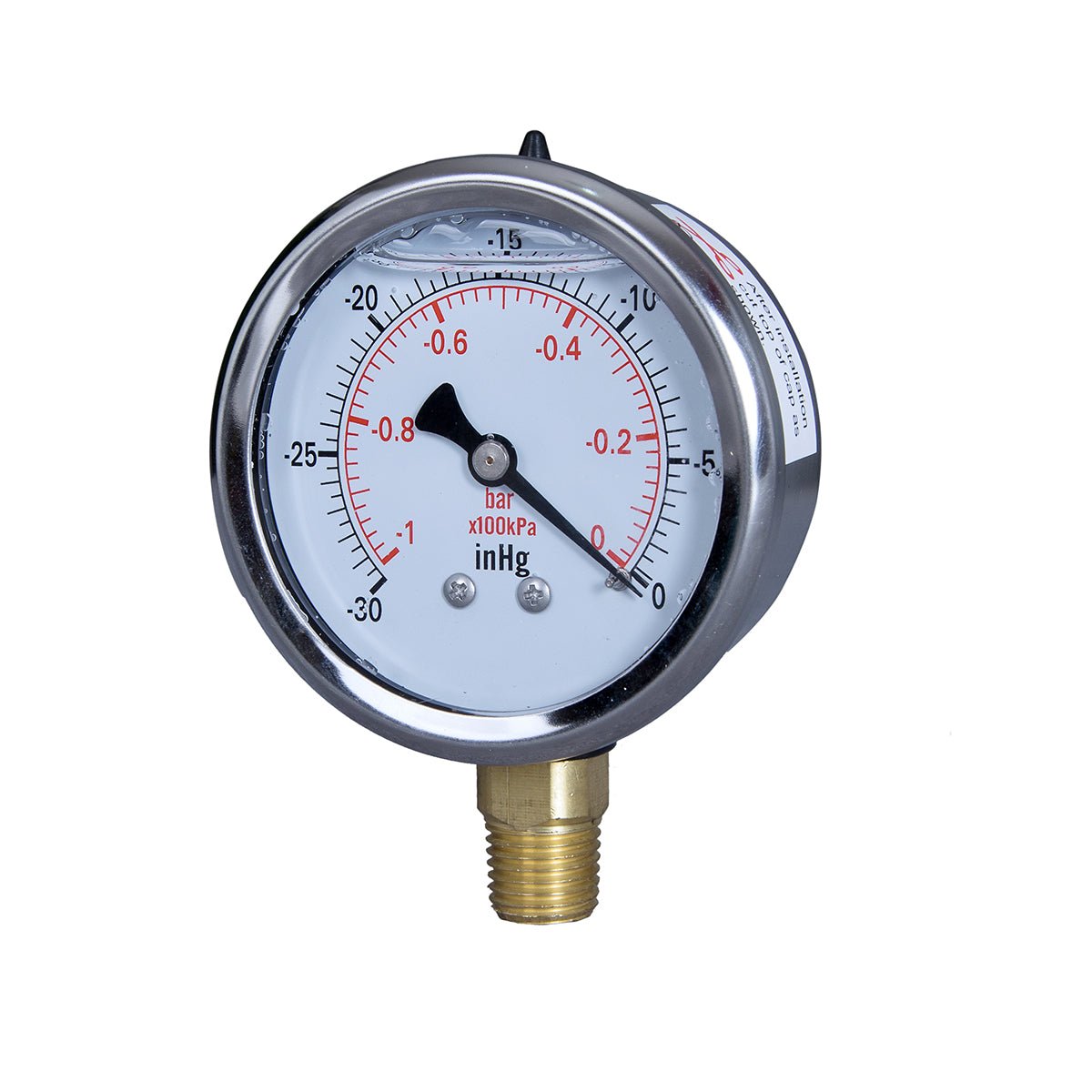
JIVTOA liquid filled pressure gauge is a standard dry gauge with one decisive upgrade: the case is completely filled with a clear fluid, almost always glycerin, that surrounds the Bourdon tube and pointer movement. That fill fluid does two jobs. It damps the pointer so it stays readable on pumps and compressors, and it lubricates the movement so the mechanism wears more slowly.
If you source gauges for equipment manufacturing, industrial distribution, or OEM branding, this guide gives you everything you need to specify them with confidence. We cover what the fill actually does (and the accuracy myth), glycerin versus silicone oil, range selection rules that prevent premature failure, mounting options, the applications where liquid fill pays for itself, and what to check when buying wholesale. Everything here comes from the production floor side of the industry: JIVTO has manufactured pressure gauges and ball valves for over 15 years in Wenzhou, China, shipping factory-direct to import buyers worldwide.

Key Takeaways
- Liquid fill damps pointer vibration and lubricates the movement. It does not change the gauge's calibration accuracy — that is set by the movement quality and its class rating.
- Glycerin fill handles roughly -20°C to +60°C; silicone oil extends service to roughly -40°C to +200°C for hot or freezing applications.
- Size the range so operating pressure sits in the middle third of the dial (~25–75% of scale): steady loads up to 75% of full scale, cyclic loads no more than ~65%.
- Match mount to installation — lower (bottom) mount for inline plumbing, back mount for panels — before you compare price quotes.
- JIVTO supplies glycerin-filled gauges factory-direct with MOQ from ~200 units, ~30-day lead time after sample confirmation, and OEM/ODM private-label options.
Table of Contents
- What Is a Liquid Filled Pressure Gauge?
- How Fill Fluid Works Inside the Case
- Glycerin vs Silicone Oil Fill Fluids
- When Vibration Makes Liquid Fill Non-Negotiable
- Choosing the Right Range and Dial Size
- Lower Mount vs Back Mount
- Liquid Filled vs Dry Gauges
- Snubbers vs Liquid Fill
- Best Applications by Equipment Type
- Fogging, Leaks, and Other Common Problems
- How a Liquid Filled Gauge Is Built: The Factory View
- Sourcing Liquid Filled Gauges Wholesale
- Shop JIVTO Liquid Filled Gauges
- FAQ
What Is a Liquid Filled Pressure Gauge?
A liquid filled pressure gauge is a bourdon tube pressure gauge whose housing is completely filled with a transparent damping fluid — typically glycerin — so that the sensing element, movement, and pointer all operate submerged inside the sealed case.
Everything that makes an ordinary gauge work is still there:
- Bourdon tube — the curved, flattened tube that flexes as pressure rises and drives the pointer through a geared movement
- Movement — the link-and-gear mechanism that converts tube deflection into rotation
- Dial and pointer — the readout, printed with the range and units
- Case and window — the housing (stainless steel or other materials) with a clear window, polycarbonate (PC) being common on modern gauges
- Fill port and plug — the small rubber plug or valve used during filling and for pressure equalization
- Process connection — usually 1/4" NPT or similar threaded fitting, in lower-mount or back-mount position
The category covers several names that describe the same thing: glycerin filled pressure gauge, oil filled pressure gauge, and liquid filled gauge are used interchangeably by buyers and manufacturers alike.
One misconception to clear up immediately, because it shapes purchasing decisions: the fill fluid does not make the gauge more accurate. Accuracy is determined by the quality of the Bourdon tube and movement and is graded under standards like EN 837-1 and ASME B40.100 — Class 1.6 is typical for a good general-service gauge, whether filled or not (GNW Shop's EN 837 accuracy class breakdown). The fill changes how the gauge behaves under vibration and pulsation, which we'll unpack next.
How Fill Fluid Works Inside the Case
Fill fluid solves two problems at once: it damps pointer oscillation caused by pressure pulses, and it lubricates the gear train so the movement resists wear over years of service (Mid-West Instrument).
Here's the sequence inside a working gauge. The Bourdon tube senses pressure and moves. In a dry gauge on a reciprocating pump or compressor, that movement transfers directly to the pointer — which is why you see needles fluttering, bouncing, or vibrating so fast they blur. Every flutter also works the gears and bearings back and forth, accelerating wear on the movement.
Submerge that same movement in viscous glycerin and the physics change:
- Viscous damping — the fluid resists rapid pointer motion far more than slow motion, so genuine pressure changes still register smoothly while high-frequency vibration gets absorbed.
- Pulsation smoothing — pressure ripples from pistons, gear pumps, and compressors average out into a stable midline reading instead of needle chatter.
- Continuous lubrication — every bearing surface and gear tooth runs in oil, reducing friction and wear.
- Sealed atmosphere — a fully filled, sealed case leaves little room for moist air, which prevents internal condensation and fogging on outdoor or washdown installations.

From the factory floor: when customers send back gauges that "stopped working," the movement inside is often worn out from years of running dry against a pulsating load. The Bourdon tube is frequently still fine. That failure pattern — worn movement, healthy tube — is exactly what liquid filling exists to prevent.
The practical consequence: on any application driven by a piston pump, compressor, or hydraulic system, a vibration resistant pressure gauge keeps the reading usable and extends the life of the movement itself.
Glycerin vs Silicone Oil Fill Fluids
Glycerin is the default fill for most general-purpose applications; silicone oil is the upgrade you specify when temperatures go beyond glycerin's comfort zone. Most buyers will never need anything but glycerin — but knowing the boundary matters when you quote equipment for harsh environments.
The service temperature split looks like this:
| Fill fluid | Approximate service temperature | Typical use |
|---|---|---|
| Glycerin | -20°C to +60°C | Standard industrial, indoor, most compressor and hydraulic work |
| Silicone oil | -40°C to +200°C | Freezing climates, hot oil lines, steam-adjacent equipment |
Glycerin wins on cost, availability, and environmental friendliness, which is why it's the standard fill on quality general-service gauges including JIVTO's lineup. Silicone costs more and handles extreme cold without becoming syrupy — at deep sub-zero temperatures glycerin thickens and the pointer responds sluggishly — and it tolerates much higher process-side heat near the case.
A few selection pointers:
- If your equipment lives indoors or in a temperate climate, spec glycerin and don't overpay.
- For outdoor equipment exposed to northern winters or desert heat, silicone fill protects both readability and the movement.
- Note that "oil filled pressure gauge" in supplier catalogs can mean either fluid — always confirm which fill is actually in the case before comparing prices.
- Some manufacturers offer blended fills (glycerin-water mixes) for specific markets; treat these as regional variants rather than a third category.
For a deeper comparison — including viscosity behavior at temperature extremes and which industries standardize on each fluid — see our guide to glycerin vs silicone oil fill.
When Vibration Makes Liquid Fill Non-Negotiable
If your gauge mounts anywhere near a motor, pump, compressor, or engine, vibration resistance isn't a nice-to-have — it's the difference between a gauge you can read and one you can't.
The classic symptom is needle chatter: the pointer trembles, jumps, or spins so fast the operator can't extract a number. On a dry gauge mounted directly to an air compressor manifold, the needle may vibrate dozens of times per second. Beyond unreadability, that constant motion hammers the movement's gear teeth and can literally shake loose screws and pivot jewels until the gauge reads permanently wrong or stops entirely (Swagelok's pressure gauge failure guide).
Applications where liquid fill should be your default specification:
- Air compressors — especially reciprocating (piston) units where tank pressure pulses with every stroke
- Hydraulic power packs and presses — pump pulsation plus machine vibration in one package
- Fuel systems and engines — engine-mounted gauges see continuous broadband vibration
- Mobile equipment — anything on wheels adds road and chassis vibration
- Washdown and outdoor installations — the sealed fill also blocks moisture ingress
If a customer reports a jumping or erratic needle on existing equipment, the first diagnostic question is whether the gauge is dry. Often the fix is simply swapping to a filled gauge — though it's worth ruling out genuine pressure oscillation first. Our troubleshooting guide to pressure gauge needle jumping walks through that diagnosis step by step.
Choosing the Right Range and Dial Size
Select a range where normal operating pressure sits in the middle third of the dial — roughly 25–75% of full scale — and keep steady pressures at or below 75% of range, cyclic pressures at or below about 65% (per Ashcroft's gauge range selection guidance).
That single rule prevents the two most common range mistakes:
- Undersized range: running near the top of the dial keeps the Bourdon tube stressed near its elastic limit constantly, which drives the mechanism toward drift and failure. Cyclic loading near the top is worse still, since each pulse fatigues the tube.
- Oversized range: a 0–600 psi gauge reading a 60 psi line squeezes the actual operating band into the first tenth of the dial, where every psi is worth a fraction of a millimeter of pointer travel. Resolution suffers and operators misread trends.
Common dual-scale ranges on general-service gauges run 0–30, 0–60, 0–100, 0–160, and 0–200 psi, each paired with a bar scale. Worked examples:
| Application | Operating pressure | Sensible range |
|---|---|---|
| Small air compressor cutoff | ~90–125 psi | 0–200 psi |
| Hydraulic power pack | ~1,500–2,500 psi | 0–4,000 psi class |
| Fuel line, carbureted engine | ~5–8 psi | 0–15 or 0–30 psi |
| Water well / booster pump | ~40–60 psi | 0–100 psi |

Dial size follows readability distance. A 1-1/2" or 2" dial suits panel clusters and tight installs viewed from arm's length; 2.5" is the versatile mid-size choice for most industrial points; larger dials earn their space on plant piping read from across the room.
Range tables, accuracy classes, connection sizes, and the rest of a datasheet deserve careful reading before you commit to an order — our walkthrough of how to read pressure gauge specifications decodes every line item suppliers put on their spec sheets.
Lower Mount vs Back Mount
Connection position determines how the gauge fits into your plumbing, and getting it wrong means rework at installation time. The two standard configurations are lower mount (connection at the bottom, 6 o'clock) and back mount (connection behind the dial, center or lower-back).
Choose based on where the gauge physically lives:
- Lower mount (bottom connection) — the default for inline and pipeline installations. The gauge stem threads directly into a tee, manifold block, or vertical riser, and the dial faces outward. This suits compressors, pumps, and hydraulic manifolds.
- Back mount (rear connection) — the choice for flush panel installation. The gauge body drops through a panel hole with the connection hidden behind, leaving only the dial visible. Instrument panels, control cabinets, and equipment dashboards use this style.
Two practical notes that save headaches: first, on back-mount gauges check whether you need a front flange and rear mounting bracket for panel securing — quoting without them stalls installs. Second, stem length matters on back-mount panels thicker than standard.
JIVTO offers both configurations in the same quality construction — for example, the 2.5" model is available as a lower-mount liquid filled unit or a back-mount version, letting you standardize internals across mixed installations. The trade-offs, dimensions, and use cases are laid out fully in our comparison of bottom mount vs back mount pressure gauge.
Liquid Filled vs Dry Gauges
Dry gauges win on price; liquid filled gauges win everywhere vibration, pulsation, or moisture shows up. Neither design is "better" in the abstract — the honest answer depends on what the gauge connects to and where it lives.
Where dry gauges remain the right call:
- Static or slowly changing pressure: water mains, gas lines, storage tanks, municipal supply
- Clean indoor environments without meaningful vibration
- High-volume, cost-sensitive OEM builds where the duty cycle justifies it
Where liquid fill earns its premium:
- Anything downstream of a piston pump or reciprocating compressor
- Mobile and engine-driven equipment
- Outdoor, marine, and washdown environments (sealed fill blocks condensation)
- Any point where operators need a readable, trustworthy indication for process decisions or safety
Cost-wise, expect liquid filled versions to carry a modest premium over equivalent dry gauges — a gap that shrinks to irrelevance when you factor in the avoided costs of unreadable readings, premature movement wear, and warranty returns on equipment shipped with dry gauges in vibrating applications.
The full decision framework — with pricing context, failure-mode analysis, and an application checklist — lives in our head-to-head guide to oil filled vs dry pressure gauge.
Snubbers vs Liquid Fill
Liquid fill dampens the pointer; a snubber restricts the flow of pressurized media into the gauge. They attack pulsation from opposite ends, and on severe-duty applications the right answer is both.
A snubber is a small fitting installed between the process and the gauge connection. Inside, a porous metal disc or adjustable orifice throttles sudden pressure spikes, slowing how quickly media reaches the Bourdon tube. It protects the sensing element from shock and water hammer. Fill fluid, by contrast, protects the movement and pointer from vibration-induced chatter and wear — and does nothing to limit what hits the tube.
Use this logic when specifying:
- Mild pulsation (small compressor, fuel pump) → liquid filled gauge alone is usually sufficient
- Severe pulsation or water hammer (large reciprocating pumps, fast-cycling valves, slurry) → snubber plus liquid fill
- Extreme spikes needing gauge protection but minimal damping requirement → snubber alone can work with a dry gauge
One caution: snubbers add a restriction that can clog in dirty media, so they need occasional cleaning — another reason not to spec one unless the application genuinely demands it.
Our detailed breakdown of snubber vs liquid filled gauge compares response behavior, maintenance needs, and cost so you can decide point by point.
Best Applications by Equipment Type
Three applications account for most liquid filled gauge demand: air compressors, hydraulics, and fuel systems. Each has its own specification pattern worth understanding before you order.
Air Compressors
Reciprocating compressors are the textbook case for liquid fill. Tank and interstage pressure ripple with every piston stroke, and the compressor's own motor vibration compounds the problem. A 0–200 psi dual-scale glycerin gauge with 1/4" NPT lower mount covers the majority of shop compressors, since typical cut-in/cut-out bands sit comfortably in the middle of that span. Rotary screw compressors produce smoother pressure but still benefit from fill because of machine vibration. For model-by-model recommendations, see our guide to the best pressure gauge for air compressor.
Hydraulic Systems
Hydraulic circuits combine intense pump pulsation with high operating pressures — exactly where a dry gauge fails fastest. Liquid filled gauges built for hydraulics pair heavier-duty Bourdon tubes with ranges matched to system relief settings, keeping working pressure in that middle-third zone. That combination is why machine builders increasingly ship filled gauges as standard equipment. Sizing, range pairing, and mounting details for these demanding circuits are covered in our article on the liquid filled hydraulic pressure gauge.
Fuel Pressure
Fuel systems need small-diameter gauges rated for gasoline, diesel, and compatible fuels, with fine ranges like 0–100 psi and compact 1/8" NPT connections. Vibration from the engine makes liquid fill essential here too — an unfilled fuel gauge on a running engine is nearly impossible to read. Glycerin fill also protects the fine movement from the constant micro-vibration of fuel pumps. Compatibility notes, range choices, and installation positions are detailed in our guide to the liquid filled fuel pressure gauge.
Beyond these three, liquid filled gauges serve chemical injection skids, test benches, food and beverage processing lines, irrigation systems, and HVAC chillers — anywhere pulsation, vibration, or washdown conditions coexist with the need for a dependable reading.
Fogging, Leaks, and Other Common Problems
Most liquid filled gauge complaints trace back to three causes: condensation fogging under the window, gradual loss of fill fluid, and discoloration of the fluid. All three have identifiable causes and fixes.
Fogging. Moisture condensed on the inside of the window obscures the dial. Ironically, this happens mostly to dry or partially filled gauges in humid or outdoor environments — a properly filled, sealed case leaves almost no air volume to hold moisture. Temperature swings draw humid air in through vent holes in unfilled designs; over cycles, that moisture accumulates. If you're seeing fog already, our guide to pressure gauge fogging up explains the mechanisms and remedies.
Fluid loss. A slow leak at the fill plug, window gasket, or case seal gradually lowers the fluid level. A gauge that's half-empty loses most of its damping benefit and starts behaving like a dry unit. Check the plug seating first — after shipment and altitude/temperature changes, plugs sometimes need reseating. Persistent leaks mean a gasket or case defect; replace the gauge.
Discoloration. Glycerin slowly yellows with UV exposure and age; brown fluid on a relatively new gauge suggests overheating beyond glycerin's temperature envelope or chemical attack. Either way, the fill has served its purpose poorly — evaluate whether the application exceeds the fluid's rating.
From the factory floor: a large share of "leaking gauge" warranty claims turn out to be transport-related plug seepage, fixed by pressing the plug home. We tell wholesale buyers to inspect fill level on receipt — it takes seconds per box and separates shipping issues from product defects before they become disputes.
None of these failure modes appear overnight, which is why specifying quality construction up front — proper sealing, correct fill for the temperature range, PC windows that stay clear — matters more than chasing the lowest unit price.
How a Liquid Filled Gauge Is Built: The Factory View
Understanding what goes into a liquid filled gauge explains most of the price spread between suppliers. Here's how quality units come together on a production line like ours.
It starts with the sensing element: a Bourdon tube in brass or copper alloy, formed, welded or brazed to the block, and pressure-tested. The tube's material and wall thickness set the durability ceiling — economy gauges thin this component out, which is why they fail early on pulsating service even when the dial says the same thing.
The movement — pinion gear, sector gear, links — gets assembled and calibrated against reference standards. This is where accuracy class is established: quality general-service gauges conform to EN 837-1 or ASME B40.100 conventions at Class 1.6, meaning ±1.6% of full-scale deviation. Calibration happens before filling, because the fill must never be what holds a sloppy movement together.
Case assembly follows: the movement seats in the case, the dial and PC window close it up, and the filling station evacuates and injects glycerin through the fill port, then seals it. Complete filling — no trapped air pocket — is what guarantees both damping performance and anti-condensation behavior. Stainless steel case options exist for corrosive or marine environments alongside standard materials.
Final QC checks fill integrity, pointer zero, and visual clarity before packing. When you buy from a manufacturer rather than a trading company, this is the chain you're auditing: tube stock, calibration discipline, fill completeness, seal quality. Fifteen-plus years of building gauges in Wenzhou taught us that buyers who ask about these steps get better product than buyers who ask only about price.
Sourcing Liquid Filled Gauges Wholesale
Wholesale buyers should evaluate four things before price: construction quality, customization capability, communication speed, and terms that fit import logistics. The market splits cleanly between premium Western brands, generic traders, and factory-direct manufacturers — and each serves different needs.
Premium brands (WIKA, Ashcroft, and similar) build excellent instruments but generally aren't structured to serve import buyers needing private-label product at project volumes. At the other end, thin listing-only sellers offer low prices with no engineering support and unpredictable consistency. Factory-direct manufacturers occupy the practical middle: real production capability, OEM/ODM customization, and export terms built for B2B.
When you request quotes, put these questions to each supplier:
- What is the fill fluid and fill completeness guarantee? (Glycerin standard? Vacuum-filled?)
- Which accuracy convention applies — EN 837-1 or ASME B40.100, and what class?
- Are cases stainless steel available, and what's the window material?
- What's the MOQ, sample policy, and lead time — including custom dials?
- Can they do private-label logo printing, and what does tooling cost for custom dials?
JIVTO answers those questions plainly: MOQ from ~200 units, lead time ~30 days after sample confirmation, samples in ~30 working days after tooling fee when custom dials are required, T/T advance payment, EXW China terms, and full OEM/ODM private-label logo customization with tooling quoted separately for custom dials. More guidance on vetting suppliers, comparing landed costs, and structuring first orders is in our buyer's guide to finding a wholesale liquid filled pressure gauge supplier.
Shop JIVTO Liquid Filled Gauges
Every configuration discussed in this guide maps to a concrete JIVTO product. These four cover the applications above — compressors, hydraulics, panels, and fuel systems — straight from our Wenzhou factory:
- JIVTO 2" Liquid Pressure Gauge — compact 2-inch dial, 1/4" NPT lower mount, dual psi/bar scale; ideal for compressors and tight inline points.
- JIVTO 2.5" Liquid Pressure Gauge — the workhorse size, 1/4" NPT lower mount; the versatile choice for pumps, hydraulic packs, and general industrial service.
- JIVTO 2.5" Pressure Gauge — same trusted 2.5-inch format with 1/4" NPT back mount; built for flush-panel and dashboard installations.
- JIVTO Fuel Pressure Gauge — 1-1/2" diameter, 0–100 Psi/Bar/kPa triple scale, 1/8" NPT; sized for engine bays and fuel-line monitoring.
All feature Bourdon tube sensing, brass/copper alloy internals, glycerin fill, PC windows, stainless steel case options, and EN 837-1 / ASME B40.100-convention accuracy (Class 1.6 typical).
Request a quote today: MOQ from ~200 units, ~30-day lead time after sample confirmation, T/T advance payment, EXW China terms, and OEM/ODM private-label logo printing supported (tooling for custom dials quoted separately). Contact JIVTO at jivtopressuregauge.com to start your order or request samples.
Frequently Asked Questions
Does liquid filling improve a gauge's accuracy?
No. Fill fluid damps pointer vibration and lubricates the movement, but calibration accuracy is set by the tube and movement quality under EN 837-1 or ASME B40.100 conventions — Class 1.6 is typical for quality general-service gauges, filled or dry. A liquid filled gauge reads the same pressure as its dry equivalent; it just keeps the pointer steady enough to read and slows mechanical wear.
What temperature range can a glycerin filled gauge handle?
Glycerin fill performs in roughly -20°C to +60°C service. Below that band it thickens and pointer response turns sluggish; above it the fluid degrades faster. For freezer-adjacent or high-heat applications, specify silicone oil fill, which spans roughly -40°C to +200°C. Confirm the ambient and process temperatures at the install point before ordering volume.
Why is my liquid filled gauge fogging up?
Internal fog means moisture entered the case — usually through a compromised seal or fill plug on a gauge that wasn't completely filled at manufacture. A properly vacuum-filled, sealed gauge leaves negligible air volume, so condensation shouldn't form. Reseat the fill plug if loose; persistent fogging warrants replacement and a conversation with your supplier about fill completeness QC. Full diagnosis in our fogging troubleshooting guide referenced above.
Can I refill a gauge that lost its fill fluid?
Practically, no — refilling in the field rarely restores full performance because achieving a complete, air-free fill requires vacuum filling equipment, and any residual air undermines both damping and anti-condensation function. A gauge that visibly lost fluid should be treated as compromised and replaced, especially since the leak path admits moisture too.
What pressure range should I choose?
Keep normal operating pressure between about 25% and 75% of full scale, with steady loads capped at 75% and cyclic loads at roughly 65%. Example: a compressor cutting out at 120 psi fits a 0–200 psi gauge (60% of range). This preserves tube life on the high side and dial resolution on the low side. Our spec-sheet reading guide shows how to verify ranges against datasheets.
Are liquid filled gauges worth it on an air compressor?
Yes — reciprocating compressors are the strongest case for liquid fill. Piston strokes create pressure pulsation that renders dry gauge needles nearly unreadable and wears movements prematurely. A glycerin filled 0–200 psi dual-scale gauge with 1/4" NPT lower mount solves both problems for a modest price premium, which is why most serious compressor builders now ship filled gauges as standard.
The Bottom Line
Specify a liquid filled pressure gauge wherever vibration, pulsation, or moisture would compromise a dry gauge — and match the fill fluid, range, and mount to the actual installation rather than to habit. Get those three selections right and the gauge becomes the most reliable instrument on the equipment; get them wrong and no amount of price savings compensates.
This pillar page anchors our complete cluster on liquid filled pressure gauges. Each guide below expands one decision in depth:
Continue Learning
Fundamentals & Comparisons
- oil filled vs dry pressure gauge
- glycerin vs silicone oil fill
- snubber vs liquid filled gauge
- bottom mount vs back mount pressure gauge
Troubleshooting
Applications
- best pressure gauge for air compressor
- liquid filled hydraulic pressure gauge
- liquid filled fuel pressure gauge
Buying Guides
Start there, then contact JIVTO for factory-direct pricing on the exact configurations your equipment needs.