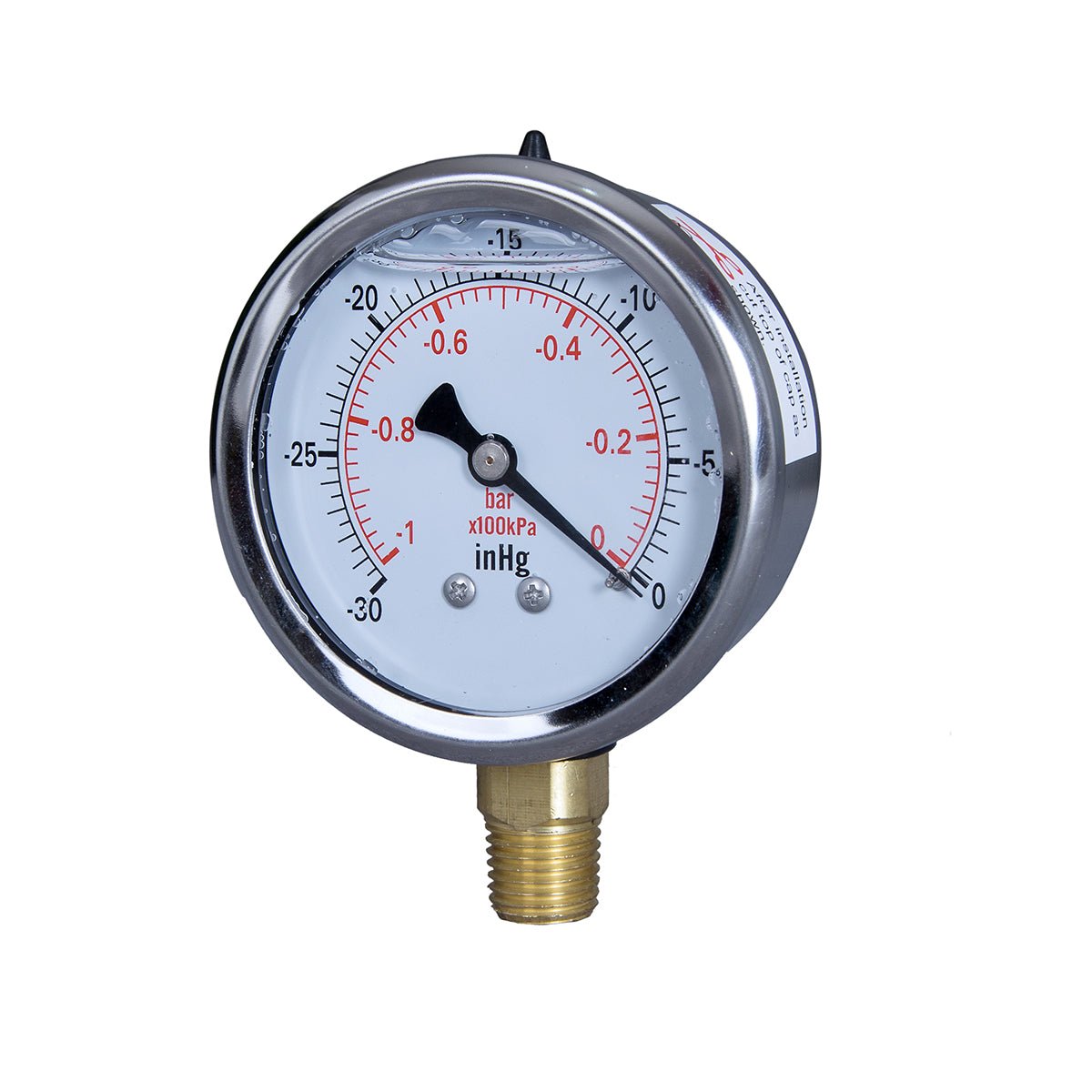
Wholesale Liquid Filled Pressure Gauge Supplier: Inside Factory-Direct Ordering (2026)
JIVTOBuying wholesale liquid filled pressure gauges factory-direct means working to published, repeatable terms: roughly 200 units minimum per SKU on standard models, about 30 days of production after sample confirmation, your logo printed on the dial as a standard capability, and an itemized quote showing unit price, tooling cost, and total on separate lines. Those are not marketing promises — they are the commercial terms JIVTO writes into the offer sheets we send to importers, distributors, and OEM buyers.
Most "wholesale supplier" pages hide behind slogans. This one shows the machinery: who this buying path fits, the real numbers, how to write an RFQ that comes back with comparable quotes, what happens between sample approval and container handoff, and which quality checks should happen before anything ships. Use it to judge us — or any gauge factory — against the same checklist.

Key Takeaways
- JIVTO's standard wholesale terms: ~200 units MOQ per SKU on standard models, ~30 days of production after sample confirmation, 100% T/T advance, EXW Wenzhou, China.
- Custom dials require tooling, quoted as its own line item; samples take about 30 working days after the tooling fee is received and order details are confirmed.
- Comparable quotes start with complete RFQs: pressure range, dial size, mount position, fill fluid, accuracy class, logo artwork, quantity, destination port.
- Private label is a manufacturing capability, not a favor — a "supplier" that cannot put your logo on a dial is reselling someone else's gauge.
- Pre-shipment QC is non-negotiable: accuracy spot checks, leak and fill-level checks, and dial legibility checks before goods leave the floor.
Who This Buying Path Is For — And Who It Isn't
Factory-direct wholesale is built for buyers whose volumes justify a relationship with the maker: importers stocking distribution, distributors building a house brand, and OEMs fitting gauges to their own equipment. If you order in the hundreds per SKU and care where every dollar goes, buying straight from a liquid filled pressure gauge manufacturer removes the reseller margin layer — and, more importantly, puts you in the room where tooling, materials, and QC decisions actually get made. The trade itself is anything but niche: industry analysts estimate global installations of pressure gauges exceeded 1 billion units in 2025, spread across manufacturing, energy, water treatment, and aerospace (SNS Insider).
It is the wrong path if you need ten gauges next week. Small rush quantities are better served by a local distributor holding stock. Factory-direct wins on unit price, customization, and consistency across repeat orders; it asks for planning discipline in return.
A note on sourcing channels, because this is where buyers lose money: marketplace listings and trading companies sit between you and the maker. Harmless on catalog items; expensive on custom work, where the tooling conversation gets relayed through a middleman who controls none of it. When the party quoting you is the party building the gauge, changes happen in hours, not email chains.
The Real Numbers: JIVTO's Standard Wholesale Terms
Everything below comes from the offer sheets we issue to importer customers. We publish it because buyers comparing a pressure gauge manufacturer in China on MOQ and lead time almost never see these figures stated plainly.
| Term | JIVTO Standard | What It Means for You |
|---|---|---|
| MOQ | ~200 units per SKU, standard models | Pilot stock and first sell-in without overcommitting capital |
| Production lead time | ~30 days after sample confirmation | Set reorder points around a one-month production window |
| Samples | ~30 working days after tooling fee received and details confirmed | Budget sample time into your launch calendar |
| Tooling | Quoted separately as its own line item (custom dials) | One-time cost you see, question, and approve explicitly |
| Payment | 100% T/T advance | No financing charges quietly baked into unit price |
| Trade term | EXW China (Wenzhou) | Your forwarder controls freight; no inflated "delivered" margins |
| Private label | Customer logo on dial — standard OEM/ODM capability | House branding without negotiation theater |
| Quote format | Itemized: unit price × quantity, tooling line, total | Line-by-line comparability between suppliers |
Three notes on reading this table. First, the sample clock starts only when two things exist together: the tooling fee and fully confirmed specifications. Half-specified RFQs stall at quotation. Second, tooling applies to custom dials — order a standard dial configuration and that line disappears entirely. Third, on certifications: ask for current certificates with your RFQ and verify them yourself. A trustworthy factory sends documents; a risky one sends adjectives.
Writing an RFQ That Gets Fast, Comparable Quotes
An incomplete RFQ gets you a guess dressed up as a quote. These eight fields turn quotations into comparable documents:
- Pressure range and units — e.g., 0–600 psi dual-scale bar/psi. Drives Bourdon tube selection and price more than any other field.
- Dial size — our liquid filled line centers on 2" and 2.5" dials; state yours explicitly.
- Mount position — lower mount or back mount, with connection size (1/4" NPT is our standard).
- Fill fluid — glycerin as the default; silicone where ambient temperatures swing past glycerin's comfort zone.
- Accuracy class — name it (Class 1.6 under EN 837-1 / ASME B40.100 is common). Quotes without a stated class are not comparable.
- Logo artwork — attach vector files if private label applies; blank otherwise.
- Quantity per SKU — real numbers per SKU, not ranges across twelve products.
- Destination port — even under EXW Wenzhou, it helps us propose packing and container loading sensibly.
Send those eight fields and the quote back should be itemized the way ours are: unit price × quantity, tooling on its own line where applicable, total at the bottom. If you're still deciding whether your application needs fill at all, our oil filled vs dry pressure gauge comparison settles that before you pay for fill you don't need.
From Sample to Shipment: The Timeline, Step by Step
Here is the full first-order sequence, numbered the way it actually runs at our works in Wenzhou, Zhejiang:

- RFQ and specification lock. You send the eight fields above; we confirm feasibility and flag anything ambiguous.
- Itemized quotation. Unit price, quantity, tooling cost (if custom dial), total. Nothing bundled, nothing hidden.
- Artwork approval and tooling fee. For private label orders we refine dial artwork until the layout is right; tooling begins once the fee is received. This is a conversation only a maker can have.
- Sample production. Approximately 30 working days after the tooling fee arrives and details are confirmed.
- Sample review and sign-off. Nothing moves to mass production until you confirm the physical sample.
- Mass production. About 30 days against the approved sample.
- Final QC and EXW handoff. Goods pass pre-shipment checks (next section), then wait in Wenzhou for your forwarder.
First orders carry steps 3–5. Re-orders skip them, which is why repeat lead times shrink to roughly the production month alone.
QC Before Shipment: What We Check — And You Should Demand From Anyone
Every batch passes three checks before it leaves our floor, and every buyer should demand the same three from any supplier:
- Accuracy spot checks — sampled gauges checked against reference instruments across the range, not just at mid-scale.
- Leak and fill-level inspection — cases verified sealed and properly bled; an air pocket inside a "liquid filled" gauge lets the pointer oscillate again and silently undoes the reason you bought liquid fill.
- Dial legibility and print check — logo registration, scale printing, and pointer alignment inspected before packing.
These checks cost minutes per batch; returns cost containers and shelf credibility. If a supplier cannot describe its pre-shipment inspection in writing, that silence is the answer.
Red Flags in Cheap Quotes
| Red Flag | Why It Costs You Later |
|---|---|
| Vague lead time ("around 2 months") | Nobody owns the delay; your launch slips with no recourse |
| No separate tooling line | Surprise fees later, or silent substitution of a standard dial for your design |
| No logo / private-label mention | You're dealing with a reseller, and your brand will never be on the dial |
| Single all-in price | Nothing to audit, nothing to compare line-by-line across factories |
| Certificates promised "on request," never specified | Ask for current certificates with the RFQ — vagueness here predicts vagueness everywhere |
| Price dramatically below the field | Usually thinner cases, softer movements, or partially filled cases — failures you discover in warranty claims |
One Container, Several Product Lines
Distributors rarely buy a single SKU, so our catalog is built for mixed-container ordering: 2" and 2.5" liquid filled gauges in 1/4" NPT lower or back mount, the 1-1/2" fuel pressure gauge, the economy dry gauge line, and ball valves — one order, one EXW handoff in Wenzhou. Mixing lines matches how your customers actually buy: vibrating equipment takes fill, calm panels take dry, and one supplier covering both keeps purchase orders short.
Request a Quote
Send us your pressure range, dial size, mount position, fill preference, quantity, and logo artwork if private label applies. We return an itemized offer sheet — unit price, tooling where relevant, total — and, for new customers, we recommend the sample-first path described above before any production commitment. Ask for current certificates alongside your RFQ; we send them with the quote.
Frequently Asked Questions
Is the ~200-unit MOQ flexible?
On standard models, ~200 units per SKU is where unit economics and meaningful batch QC stay intact, so treat it as the working baseline. Smaller trial quantities are sometimes possible on stocked configurations — ask with your RFQ. Custom dial orders carry tooling cost regardless of quantity, so shrinking volume raises the per-unit burden of that fixed line.
What artwork format do you need for dial logos?
Vector files (AI, PDF, or EPS) work best — they scale cleanly to dial printing and hold fine registration. Include brand color references so the print matches your other branded components. We confirm the dial layout proof with you before sample production, and the physical sample is the final arbiter of print quality before mass production starts.
Are re-order lead times shorter than the first order?
Yes, materially. A first order includes tooling and roughly 30 working days of sample production before mass production begins. Once a specification and sample are confirmed, re-orders go straight into the ~30-day production run against the approved sample — no artwork loop, no tooling wait. This is why serious distributors place a considered first order and then ride the short re-order cycle.
What does EXW Wenzhou mean for my shipping?
EXW (Ex Works) means the goods are made available to you, packed and ready, at our facility in Wenzhou, and main carriage from that point is arranged by you — usually your freight forwarder, who books ocean freight, insurance, and destination clearance. The upside is transparency: you pay your actual freight lane cost instead of an unknown margin folded into a "delivered" price. When comparing an EXW quote against a CIF or DDP quote from another supplier, add your own known freight cost to the EXW figure — that sum is the honest comparison.