Oil Filled vs Dry Pressure Gauge: Which Wins Where? (2026)
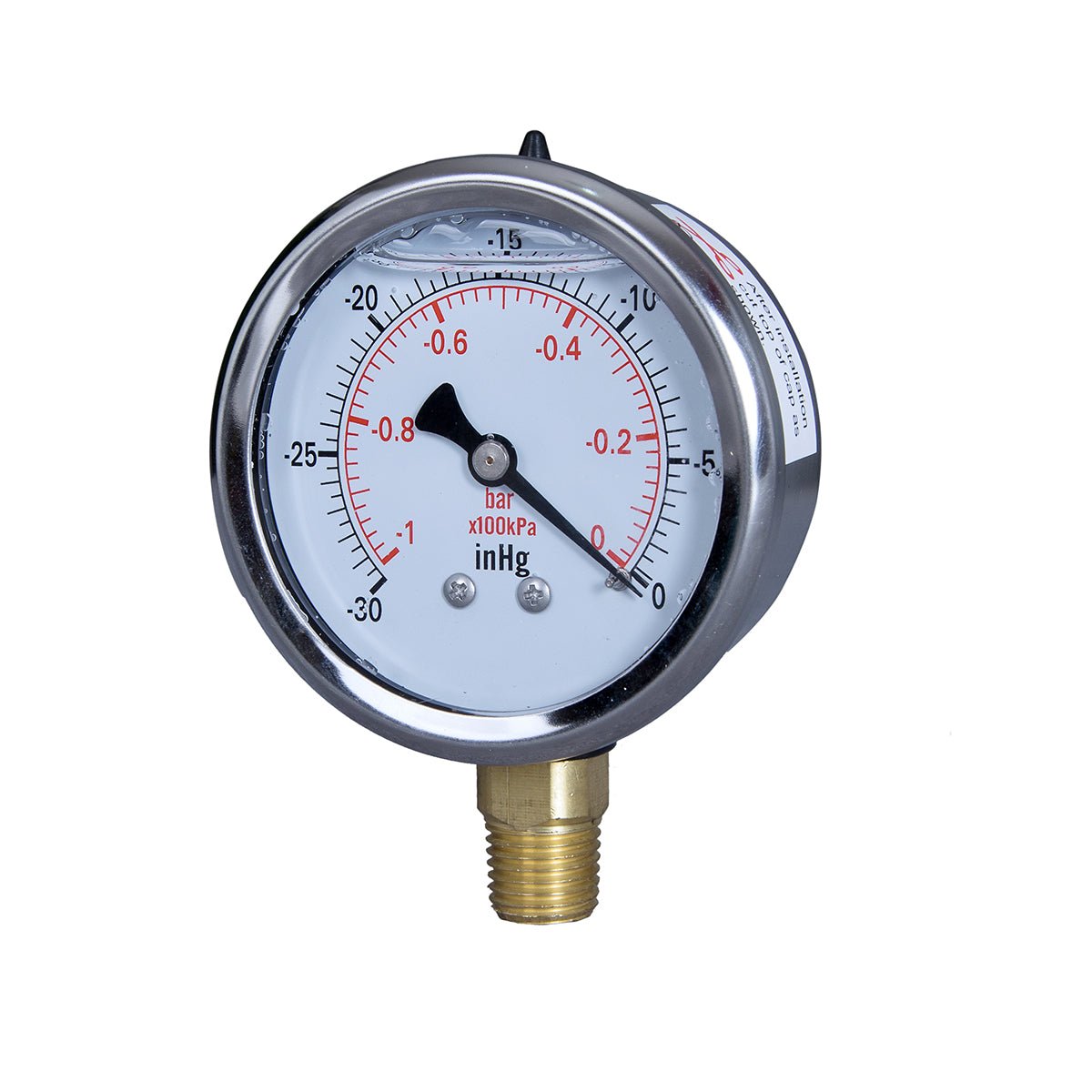
JIVTOA liquid filled (oil filled) pressure gauge wins wherever machinery shakes: pumps, compressors, hydraulic power units, and any outdoor or wash-down install. A dry gauge wins everywhere else — stable pressure lines, clean compressed air, panels out of the sun, and anywhere purchase price decides the deal. Both types read pressure with the same Bourdon tube and meet the same EN 837-1 / ASME B40.100 accuracy classes, so this is not a question of which one measures better. It's a question of which one survives your application longer.
We make both. JIVTO has manufactured pressure gauges in Wenzhou, China for more than 15 years, and our catalog deliberately includes an economy dry line alongside the liquid filled range — so this comparison is honest rather than one-sided. Below you'll find a side-by-side spec table, the failure modes we see in returned gauges, a cost-of-ownership way to think about price, and a checklist you can run before ordering. If you're new to the category, start with our complete liquid filled pressure gauge guide, then come back here for the head-to-head decision.

Key Takeaways
- Liquid fill damps pointer vibration and lubricates the movement — it does not change calibration. Both types hit Class 1.6 accuracy under EN 837-1 / ASME B40.100.
- Choose liquid fill for pumps, compressors, hydraulics, outdoor exposure, and humidity. The sealed, fluid-filled case stops both mechanical wear and window fogging.
- Choose dry for stable pressures, clean or oxygen service, extreme temperatures beyond glycerin's roughly -20°C to +60°C range, and tight budgets.
- On vibrating equipment, repeated replacement of cheap dry gauges usually costs more within a year than one liquid filled gauge that lasts the machine's life.
Oil Filled vs Dry Pressure Gauge: Side-by-Side Comparison
| Category | Liquid Filled (Oil Filled) | Dry | Winner |
|---|---|---|---|
| Best for | Pumps, compressors, hydraulics, outdoor/mobile equipment | Stable lines, clean air, panels, general service | Depends |
| Vibration damping | Glycerin bath damps pointer flutter and pulsation | None — pointer reacts directly | Liquid |
| Movement wear | Lubricated by fill fluid; slower wear on cyclic loads | Unlubricated gear wear accelerates under vibration | Liquid |
| Window fogging | Sealed case resists condensation internally | Economy glass windows fog in humid/cold cycling | Liquid |
| Temperature range | Roughly -20°C to +60°C with glycerin fill | Wider ambient tolerance; no fluid to freeze or thin | Dry |
| Dial readability | Slightly muted through fluid layer | Crisp, direct view of dial and pointer | Dry |
| Clean/oxygen service | Not standard — fill fluid complicates certification | Standard choice; oxygen-rated dry versions available | Dry |
| Unit price | Higher (case sealing, fill, stainless options) | Lower — simplest construction to build | Dry |
| Lifespan on vibrating equipment | Years; the fill absorbs what kills movements | Often months before movement damage shows | Liquid |
| Our verdict | Buy for anything that shakes, sits outside, or sweats | Buy for everything calm, clean, and cost-driven | Tie |
What the Fill Fluid Actually Does (and Doesn't Do)
The fill does exactly three jobs: it dampens pointer oscillation from vibration and pulsation, it lubricates the pinion and bearing points of the movement, and it seals the case against internal condensation (Mid-West Instrument). That's the whole list. A persistent myth says the fluid somehow improves accuracy or changes calibration — it doesn't. Accuracy is set by the Bourdon tube quality and the movement class rating, and both our liquid filled and dry gauges are built to Class 1.6 under EN 837-1 / ASME B40.100. If a supplier claims their fill fluid makes a gauge "more accurate," treat it as marketing.
The fluid choice matters more than most buyers expect. Standard glycerin handles roughly -20°C to +60°C of ambient service; below that it thickens and the pointer gets sluggish, above it and it thins out. Silicone oil extends that envelope dramatically, which is why refrigeration plants and foundries specify it differently. We break down the trade-offs — viscosity behavior, cost, food-contact considerations — in our dedicated glycerin vs silicone oil fill comparison.

One construction note worth knowing when comparing quotes: liquid filled cases must be truly sealed and fully bled of air, because an air pocket lets the pointer oscillate again. Cheap liquid filled gauges with partial fills give liquid fill a bad name. Ask how the unit is filled and bled before you compare prices.
When a Liquid Filled Gauge Wins (and What Kills Dry Gauges)
Liquid filled gauges win wherever the machine itself moves. Reciprocating pumps, screw and piston compressors, hydraulic power packs, diesel engines, and mobile equipment all generate continuous vibration plus pressure pulsation. In that environment the dry gauge's unlubricated movement takes a beating: gear teeth wear, play develops, and the pointer starts sticking or fluttering until the reading is useless (Swagelok's top five pressure gauge failure causes).
What we see coming back: When JIVTO receives failed gauges from customer audits, the dominant failure mode on vibrating installations is a worn-out movement in a dry case — gears worn past recovery, sometimes within months of install. The second most common is a fogged or corroded window on an economy dry gauge mounted outdoors. Neither failure happens to the liquid filled equivalent on the same machine.
Two warning signs tell you a dry gauge is losing that fight. First, pointer flutter or chatter on a running machine — the needle vibrates so hard you can't read a value. Second, a creeping or sticking pointer between stop and start cycles, which indicates wear inside the movement. If you're already seeing either symptom, our guide to diagnosing pressure gauge needle jumping walks through the causes and fixes.

Moisture is the quieter killer. A dry case breathes with temperature swings, drawing humid air in and letting condensation form on the inside of the window. Over months this clouds the dial and rusts bare steel internals. The sealed, fluid-packed case simply has nothing to breathe.
When a Dry Pressure Gauge Is Honestly the Better Choice
Dry gauges win four ways, and pretending otherwise would cost you money.
Cost. A dry gauge is the simplest instrument in the industry to manufacture — painted steel case, glass window, brass/copper alloy movement, no sealing or filling steps. For high-volume OEM panels where the pressure is steady, spending more on fill buys nothing.
Temperature extremes. Glycerin thickens near -20°C and thins approaching +60°C. A dry gauge has no fluid to worry about, so steam-adjacent cabinets, unheated warehouses, and cold-climate outdoor installs without insulation often favor dry — or liquid filled units specified with silicone fill instead.
Readability and cleanliness. Looking through even clear fluid slightly softens the dial view, and in food, pharmaceutical, and oxygen service, a liquid-filled case introduces a fluid you'd rather not certify. Oxygen lines in particular should always use properly cleaned, oxygen-rated dry gauges — never a standard liquid filled unit.
Lifespan in gentle service. On a stable air line with minimal pulsation, a quality dry gauge runs for many years; the wear mechanism that liquid fill protects against barely operates. This is why asking about expected dry pressure gauge lifespan only makes sense in context — the same model might last five times longer on a calm line than on a compressor head.
Cost of Ownership: Unit Price vs Replacement Frequency
The cheapest gauge is not always the low-cost gauge. Judge by cost per year of reliable reading, not price per unit.
| Scenario over 12 months | Dry gauge | Liquid filled gauge |
|---|---|---|
| Stable line, panel-mounted | 1 unit, no replacements | More than needed |
| Compressor discharge, constant vibration | 2–4 replacements common | 1 unit survives |
| Outdoor, freeze-thaw climate | Fogging forces early swap | 1 unit survives |
On vibrating equipment, buyers who spec economy dry gauges typically replace them multiple times per year — and each replacement means labor, downtime, and a period of unreadable pressure. One liquid filled gauge sized correctly for the same duty usually outlasts the machine it's monitoring — a lifespan advantage AutoMeter also documents for liquid-filled gauges in harsh environments. Reverse the logic for calm applications: fitting liquid filled gauges across thousands of stable panel points inflates project cost with zero reliability gain. Match the construction to the environment and both choices are economical.
Decision Checklist: Which Should You Order?
Run down this list before placing a purchase order:
- Is the pressure source a pump, compressor, or hydraulic circuit? → Liquid filled
- Is the equipment mounted outdoors, exposed to wash-down, or in humidity? → Liquid filled
- Does the existing gauge show pointer flutter or sticking? → Liquid filled
- Is the line oxygen service, food/pharma clean service, or gas-critical? → Dry (properly rated)
- Is ambient temperature outside roughly -20°C to +60°C? → Dry, or silicone-filled liquid
- Is the pressure rock-steady and the location protected? → Dry
- Is the bill of materials price-sensitive across hundreds of stable points? → Dry
If you answered "liquid filled" two or more times, buy liquid filled — vibration and moisture failures compound quickly.
JIVTO Liquid Filled and Dry Gauge Options
JIVTO manufactures both sides of this comparison. Our JIVTO 2" and 2.5" Liquid Pressure Gauges come glycerin filled in stainless steel case options, with 1/4" NPT connections in lower or back mount, dual psi/bar scales, and Class 1.6 accuracy per EN 837-1 / ASME B40.100 — the configuration that covers most pump, compressor, and hydraulic applications. Our dry gauge line (1.5" and 2", steel case, glass window) remains available for stable-service and budget applications, because forcing liquid fill where it isn't needed isn't in your interest or ours.
Both ranges are available factory-direct with OEM/ODM logo branding. Typical terms: MOQ around 200 units, approximately 30-day lead time, T/T advance payment, EXW Wenzhou, China. To match a gauge to your application or request samples, ask for a quote through jivtopressuregauge.com — include your medium, pressure range, mounting, and environment, and our engineers will confirm the right construction before you commit.
Verdict Summary
| Category | Winner |
|---|---|
| Vibration and pulsation | Liquid filled |
| Humid or outdoor installs | Liquid filled |
| Movement longevity under cyclic load | Liquid filled |
| Purchase price | Dry |
| Temperature extremes | Dry |
| Readability crispness | Dry |
| Oxygen and clean service | Dry |
| Overall | Liquid filled for dynamic equipment; dry for stable, clean, budget-driven service |
There's no universal winner — there's a right tool per application. Spend on liquid fill only where vibration, pulsation, moisture, or movement wear will actually occur.
Frequently Asked Questions
Does liquid filling improve gauge accuracy?
No. Fill fluid dampens pointer movement and lubricates the mechanism; it does not alter calibration. Accuracy comes from the Bourdon tube and movement quality, expressed as a class rating such as Class 1.6 under EN 837-1 / ASME B40.100 — identical ratings apply to comparable dry and liquid filled models. What fill improves is readability on vibrating machines and service life of the movement.
Can I convert a dry pressure gauge into a liquid filled one?
Not practically. Proper liquid filled gauges are designed and assembled as sealed systems — the case gasket, fill plug, and bleed process all matter, and simply pouring fluid into a dry case leaves air pockets that defeat the damping. Replace the unit with a purpose-built liquid filled gauge instead.
How long does a dry pressure gauge last?
It depends almost entirely on the environment. On a stable, low-pulsation line, a quality dry gauge commonly serves for many years without issue. On a compressor or reciprocating pump, movement wear can render a dry gauge unreliable within months — which is exactly the scenario where a liquid filled unit pays for itself. Specify by application, not by a generic lifespan number.
Are liquid filled gauges safe for oxygen service?
No. Standard glycerin-filled gauges should never be used on oxygen lines. Oxygen service requires specially cleaned, oil-free, oxygen-rated components, and those are supplied as dry constructions. Using a liquid filled gauge on oxygen risks contamination and fire — this is one case where the dry gauge isn't just cheaper, it's the only correct answer.