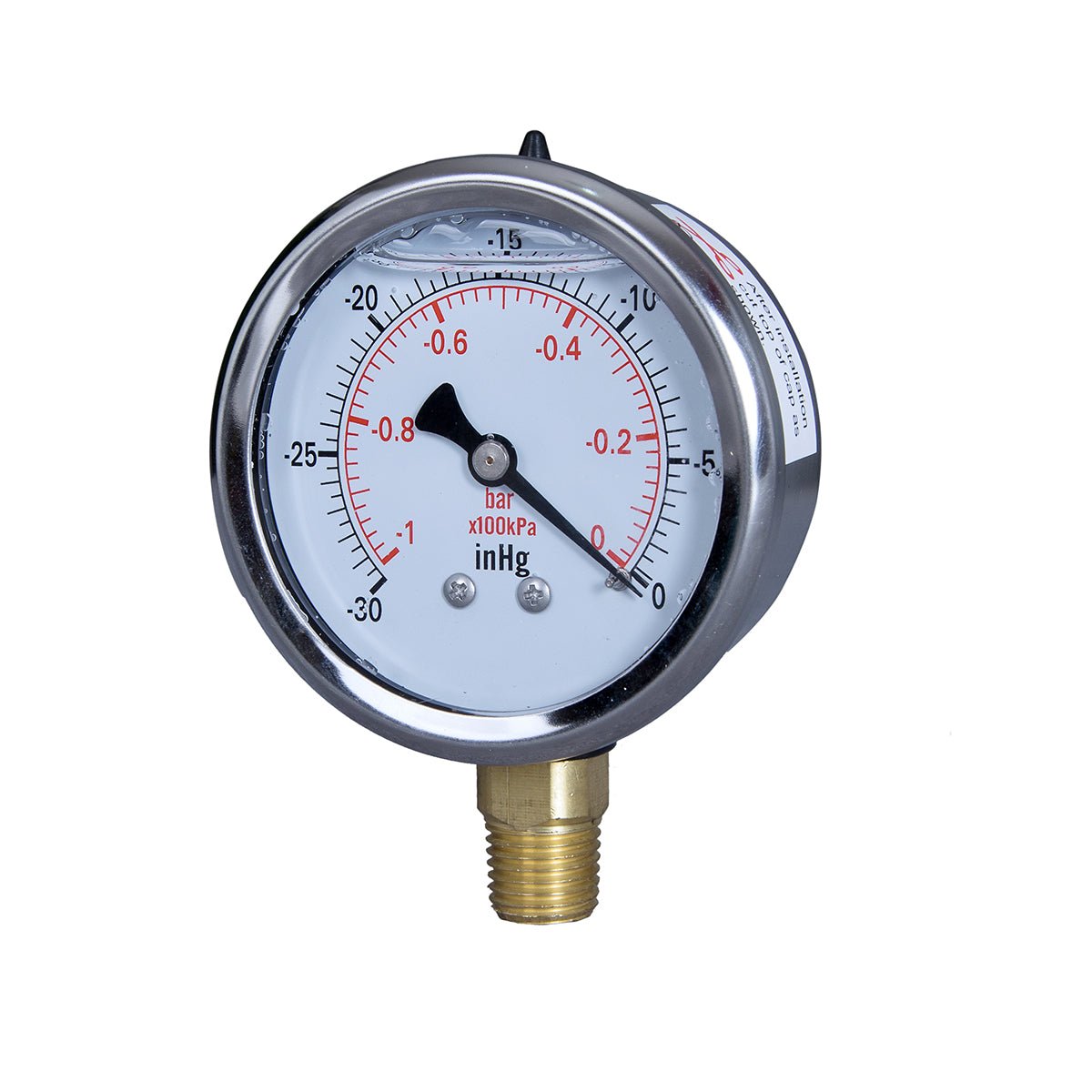
Glycerin vs Silicone Oil Filled Pressure Gauge: Which Fill Fluid Do You Need?
JIVTODefault to glycerin. For most industrial installs — pumps, compressors, hydraulic lines, panels inside a plant — glycerin is the right gauge case fill fluid, and it is what we ship as standard. Specify silicone oil only when temperature demands it: sustained outdoor cold below glycerin's comfort zone or ambient heat above roughly +60°C.
That verdict comes from our order book, not a brochure. JIVTO has built liquid filled pressure gauges in Wenzhou for over 15 years, and our standard 2" and 2.5" line leaves the factory glycerin-filled because that is genuinely the correct choice for the large majority of service. Silicone fill is a real option we offer on OEM request — but it earns its higher price only in specific conditions. This page lays out exactly when each fluid wins, so you pay for silicone only when you need it. New to the category entirely? Start with our complete liquid filled pressure gauge buyer's guide first.

Key Takeaways
- Glycerin fill handles roughly -20°C to +60°C of ambient service (industry convention); below about -6°C it thickens noticeably and the pointer turns sluggish.
- Silicone oil stays usable across roughly -40°C to +200°C with far more stable viscosity — the choice for outdoor winter installs, refrigeration plants, and hot process areas.
- Fill fluid damps vibration and lubricates the movement. Neither fill changes calibration accuracy itself.
- Neither fluid suits oxygen service. Oxygen work needs specially cleaned, oil-free dry gauges.
- Both fills share the sealed-case benefit that stops internal condensation and window fogging.
What Gauge Case Fill Fluid Actually Does
The fill does three jobs and nothing more. First, it damps: a Bourdon tube under pulsating pressure makes the pointer flutter, and every flutter grinds the movement's gear teeth. The viscous drag of the fluid absorbs that oscillation before it reaches the movement. Second, it lubricates the pinion and bearing points, which is why filled movements survive vibrating equipment for years. Third, the fully sealed, bled case keeps humid air out, which stops the internal condensation that clouds cheap dry-gauge windows (Mid-West Instrument).
What it does not do is improve accuracy. Accuracy class is set by the Bourdon tube and movement quality — our glycerin-filled and silicone-filled gauges meet the same Class 1.6 targets under EN 837-1 / ASME B40.100 as their dry equivalents. Any supplier claiming a fill fluid "increases accuracy" is selling marketing, not physics.
If your real question is whether to buy a filled gauge at all versus a dry one, that decision lives in our oil filled vs dry pressure gauge comparison. This page assumes you want liquid fill and are choosing between fluids. And if your current gauge already shows a cloudy window, see our guide to a pressure gauge fogging up before blaming the fill type — fogging usually traces to case sealing, not fluid choice.
Glycerin vs Silicone Oil: Side-by-Side Comparison
| Category | Glycerin Fill | Silicone Oil Fill |
|---|---|---|
| Ambient service range | Roughly -20°C to +60°C | Roughly -40°C to +200°C |
| Cold weather behavior | Thickens noticeably below ~ -6°C; pointer lags | Stays fluid; minimal damping change |
| Heat behavior | Thins above +60°C; damping weakens | Stable through high ambient heat |
| Viscosity stability | Varies strongly with temperature | Stable across wide swings |
| Oxygen service | Not compatible | Not compatible |
| Food-compatible grades | Available (food-grade glycerin) | Not typical |
| Relative cost | Economical — the standard | Typically higher |
| Typical applications | Indoor plants, pumps, compressors, hydraulics, general process | Outdoor winter sites, refrigeration/cryogenic adjacency, foundries, boiler areas |
Treat both temperature windows as industry conventions rather than absolute walls — exact figures vary by fluid grade and manufacturer datasheet, so confirm the datasheet before finalizing a spec (Anglera). The practical pattern holds everywhere, though: glycerin's weakness is cold, silicone's strength is range.

Choosing by Scenario: Four Rules We Apply Daily
Rule 1 — Indoor plant, ambient above freezing: glycerin
If the gauge lives indoors where winter nights stay above roughly -5°C, glycerin is unambiguous. It damps properly year-round, costs less, and food-grade glycerin is available for lines near food or beverage processing. Around 90% of the filled gauges we ship fit this description — from plant process lines to compact liquid filled fuel pressure gauge builds on small engines.
Rule 2 — Outdoor winter installs: silicone
This is the classic silicone fill gauge cold weather case. An unheated pipeline in Harbin or a Minnesota wellhead will push glycerin past its limit: below about -6°C it thickens until the pointer drags, and near -20°C response becomes unusably slow. Silicone oil keeps working where glycerin gives up, which is why refrigeration plants and northern outdoor stations specify it despite the price premium.
Rule 3 — Hot process areas: silicone
The mirror image. Boiler rooms, furnace surroundings, and equipment rooms without climate control routinely exceed +60°C ambient. Glycerin thins out there, damping fades, and the pointer starts fluttering again — the exact problem the fill was bought to solve. Silicone's stability to roughly +200°C covers it (silicone oil: -50°C to +200°C long-term service rating — Alibaba).
Rule 4 — OEM volume orders: decide per install site
If you're an equipment builder shipping machines to varied climates, don't pick one fluid globally. Map fill to destination: glycerin for domestic and temperate-market units, silicone for export models headed to extreme-cold or high-heat regions. On volume runs we can split a single order between both fills.
What to Tell Your Supplier: The Four Questions
When a customer asks us "glycerin or silicone?", we ask four questions back — and any competent supplier should:
- What is the lowest ambient temperature at the install site? Not the media temperature — the air around the gauge in the worst week of winter.
- Is the gauge outdoors or sheltered? Outdoor exposure adds wind chill cycling and sun load that indoor specs miss.
- What is the media temperature? A hot line in a cold shed stresses the case from both directions.
- Will the gauge ever contact oxygen or an oxidizer? If yes, the conversation changes completely — fill fluids are out, and you need a specially cleaned, oxygen-rated dry gauge.
Answers to those four questions determine the fluid in nearly every case. Bring them to your RFQ and you'll skip the guesswork entirely.
JIVTO Liquid Filled Gauges: Glycerin Standard, Silicone on Request
Our standard liquid filled line comes in 2" and 2.5" dial sizes with 1/4" NPT lower or back mount connections, factory-sealed and fully bled with glycerin — the correct default for the general industrial service described above. For OEM buyers whose site surveys call for it, silicone oil fill is available on request within volume production runs.
We're a factory-direct manufacturer in Yueqing/Wenzhou, Zhejiang, trading as JIVTO with 15+ years behind the line, so fluid specification happens at the source rather than through a distributor guessing at a catalog. To get a quote: tell us dial size, mount, quantity, and your answers to the four questions above. Typical terms are MOQ around 200 units, approximately 30-day production lead time, and EXW China pricing. Request a quote and we'll confirm fill fluid, range, and connection against your application before anything ships.
Frequently Asked Questions
Can I refill my gauge with a different fill fluid myself?
We don't recommend field refills, honestly. A liquid filled case only damps correctly when it is completely full and free of air bubbles — open the filler plug in a dusty workshop and you trap air, moisture, and contamination inside. Mixing fluids can also change viscosity unpredictably, and the case may no longer seal properly afterward, which invites exactly the internal condensation the fill prevents. If you ordered the wrong fluid, replace the gauge or send it back for factory refilling; sealing integrity matters more than the fluid swap itself.
Does silicone fill make a gauge more accurate?
No. Both glycerin and silicone damp pointer vibration; neither changes calibration. Accuracy is fixed by the Bourdon tube and movement class. The fluids differ in where they keep damping effectively — temperature range — not in how precisely the gauge reads.
How cold is too cold for a glycerin-filled gauge?
Watch below -6°C: that's when glycerin starts thickening enough to notice, with the pointer moving sluggishly during startup. By roughly -20°C, glycerin fill is at its practical floor. If your gauge reads slowly on cold mornings but recovers by mid-morning, cold-thickened glycerin is the likely cause — time to spec silicone for next season.
Why can't silicone-filled gauges be used on oxygen service?
Pressurized oxygen plus any oil film is an ignition hazard, and gauge fill fluids are no exception — this applies to glycerin and silicone alike. Oxygen service demands specially manufactured, thoroughly degreased, oil-free dry gauges built to oxygen cleaning standards. Tell your supplier upfront if oxygen or oxidizers are anywhere in the system.
The Bottom Line
Glycerin is the workhorse; silicone is the specialist. Choose glycerin unless the install site sees sustained cold below glycerin's range or heat above +60°C — then pay for silicone knowingly. When in doubt, run the four questions with your supplier rather than defaulting upward in cost. For sizing, ranges, connection options, and the full selection checklist, return to the complete liquid filled pressure gauge guide.