Liquid Filled Fuel Pressure Gauge: How to Test Small Engine and EFI Fuel Systems
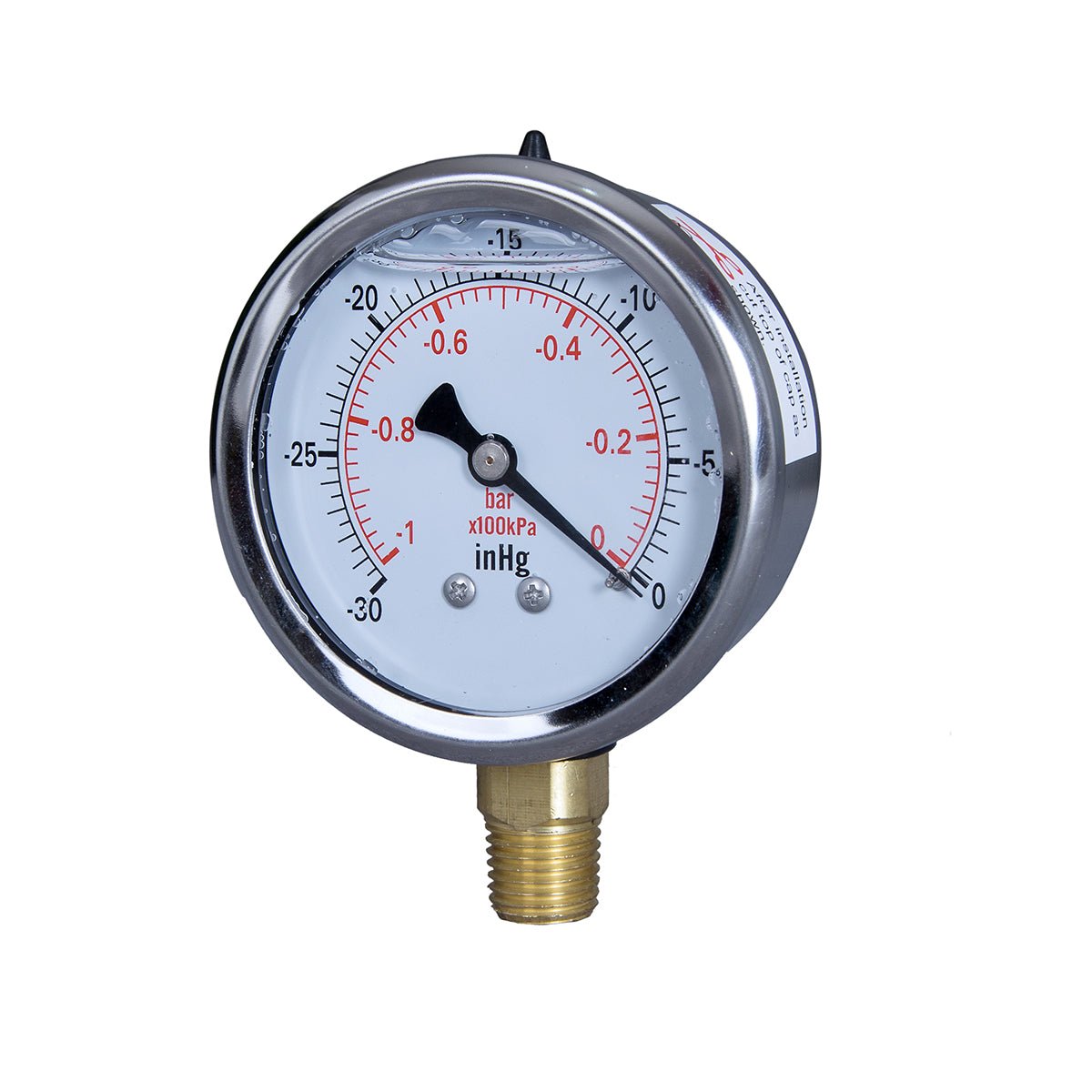
JIVTOA liquid filled fuel pressure gauge is a compact, oil-damped test gauge — typically with a 1-1/2" dial, a 0-100 PSI scale, and a 1/8" NPT connection — used to measure fuel system pressure on small engines, generators, motorcycles, ATVs, and performance tuning benches. The liquid inside the case damps the pointer, which matters more here than on any workbench gauge: single-cylinder engines vibrate hard enough to make an ordinary dry needle unreadable while the engine runs.
If you diagnose hard-starting generators, chase lean-running complaints on a pumped EFI motorcycle, or watch fuel delivery during tune sessions, this page covers where the gauge fits, how to read its results, and how to hook it up correctly. It comes from the manufacturing side: JIVTO builds this exact format at volume in Wenzhou, China, with over 15 years in pressure instrument production.

Key Takeaways
- Small engines, generators, and performance carbureted and EFI test setups run roughly 5–60 psi, so a 0-100 psi gauge keeps live readings in the readable middle of the dial.
- Liquid fill is genuinely functional on fuel test gauges: it damps pointer flutter from single-cylinder engine vibration instead of leaving you guessing between blurred extremes.
- A 1-1/2" dial reads fine at test-bench distance, and the 1/8" NPT connector suits the small adapters used on fuel rails and test lines.
- For continuous immersion in aggressive or alcohol-blended fuels, confirm media compatibility before a permanent install — a factory supplier can answer this directly.
Why Fuel Testing Needs a Small, Filled Gauge
Three constraints shape the right fuel pressure test gauge: range, space, and vibration.
Range. Fuel systems on this equipment sit anywhere from low-single-digit psi on gravity-fed carbureted systems to around 60 psi on performance EFI setups. That spread is exactly why 0-100 psi is the practical scale: every common system lands mid-dial, where Bourdon gauges read most accurately and easily.
Space. Fuel rails, generator frames, and motorcycle tanks leave little room for hardware. A 1-1/2" dial is deliberately compact — small enough to hang off a test adapter without leveraging against fittings, yet legible at bench distance because the scale carries only three units (PSI, Bar, kPa).
Vibration. This is where liquid fill earns its place. A single-cylinder engine shakes its whole fuel line, and a dry movement responds with a buzzing, half-visible pointer — fill fluid cushions the movement and absorbs the mechanical shock that vibration otherwise delivers inside a dry case (Mid-West Instrument). Filling the case with glycerin hydraulically damps that motion so the needle settles on a readable value — the same physics explained in our complete liquid filled pressure gauge buyer's guide, applied at small scale.
One boundary worth knowing: standard glycerin fill serves ambient temperatures of roughly -20°C to +60°C. Winter field diagnostics below that band behave differently — if your testing happens outdoors in deep cold, see our glycerin vs silicone oil fill comparison before specifying.
Where a Fuel Pressure Test Gauge Gets Used
Four scenarios cover nearly every request we see for this gauge format.
1. Diagnostic test lines on small engines and generators
The classic use: tee the gauge into the fuel line between tank and carburetor while the engine runs, then compare the reading against the service manual's spec. Hard starting, stalling under load, and surging often trace to weak pump output, a clogged strainer, or a vented-tank problem — visible within seconds of startup.
2. Motorcycle and ATV fuel systems
Pumped EFI machines typically run tens of psi on the rail, and their cramped frames make a compact 1.5" gauge far easier to route than full-size instrumentation. Mechanics hang it off a test port during diagnosis, then remove it once the reading is captured.
3. Performance tuning benches
Carbureted performance builds and EFI test rigs benefit from continuous fuel-delivery visibility: watching supply pressure hold steady as demand rises exposes pump fade and regulator drift that otherwise masquerade as tuning issues. On a bench the dial sits at eye level, where its size is no limitation.
4. Permanent install vs temporary hook-up
A temporary hook-up during diagnosis is forgiving; a permanent mount on a modified fuel system demands more thought — constant fuel contact, sustained vibration duty, heat cycling. Liquid fill handles the vibration part well — by reducing wear on internal parts, liquid-filled gauges typically last longer than dry ones in harsh environments (AutoMeter) — and the open question becomes whether the wetted materials tolerate that specific fuel continuously.
Reading the Results: Low, Steady-High, and Flutter
Interpretation always ends with the manufacturer's spec for the specific engine, but three patterns recur:
- Low and steady. Supply pressure below spec usually points to a tired pump, a clogged filter or strainer, or a pinched line. Confirm the spec first, then work upstream from the gauge.
- Steady but too high. On regulated EFI systems, elevated rail pressure suggests a sticking regulator or blocked return path — the pump may be healthy while the control side fails.
- Flutter or dropping needle. Fluctuation under load can indicate pump cavitation or air leaking into the suction side. Liquid filling does double duty here: it suppresses vibration-induced buzz so genuine fluctuation stands out instead of drowning in engine shake.
Treat the gauge as a symptom reporter rather than a verdict: it shows where in the chain to look; the service manual says what each value means for that machine.
Installation Notes: Threads, Orientation, and Mounting Style
Get three details right and the gauge will simply work.
Thread size match. The 1/8" NPT connector on compact fuel gauges suits the small brass adapters used on fuel-rail test ports and inline tees. Verify your adapter's thread before ordering — NPT is tapered and seals on the thread form, so mixing standards damages small female ports quickly. Seal with a thread sealant rated for gasoline, and tighten modestly: over-torque cracks housings.
Orientation. Mount the dial where it reads face-on from your working position. Lower-mounted connectors suit inline test-line installs; if the gauge hangs off a rail, check that the case clears exhaust heat — glycerin's comfort zone tops out near +60°C ambient.
Temporary vs permanent. For a temporary hook-up, connect, run the test, depressurize, and remove. For a permanent install, treat wetted-material compatibility seriously. Brass internals are standard for fuel service, but continuous immersion in aggressive or high-alcohol blends deserves explicit confirmation — ask the supplier before installing, not after a leak. JIVTO fields these compatibility questions daily from the factory floor.
Product Spotlight: JIVTO Fuel Pressure Gauge
The JIVTO Fuel Pressure Gauge packages everything above into one SKU: a 1-1/2" diameter dial, a 0-100 Psi/Bar/kPa triple scale, a 1/8" NPT connector, and liquid fill for vibration damping. Brass internals come standard for fuel service.
Because JIVTO manufactures this gauge at volume in Wenzhou, Zhejiang, it also works as a private-label component: tool brands commonly order OEM logo dials for fuel-injection test kits.
For pricing, custom dial branding, or a compatibility answer for a specific fuel blend, request a quote — the factory replies directly, with no distributor layer in between.
Frequently Asked Questions
Is 0-100 psi the right range for fuel pressure testing?
For this equipment class, yes. Systems run roughly 5-60 psi depending on design — low-pressure carbureted setups at the bottom, performance EFI toward the top — so 0-100 psi places every common reading mid-dial, where accuracy and readability peak.
Can I really read a 1-1/2 inch dial at working distance?
At test-bench distance — roughly arm's length — yes. With only PSI, Bar, and kPa on the dial and nothing else crowding it, the numerals stay large enough to read despite the compact case.
Is the liquid fill necessary, or just a marketing feature?
Necessary. Single-cylinder engines and generators transmit strong vibration into the fuel line, turning a dry pointer into an unreadable buzz. Glycerin fill damps the movement mechanically, which is why serious fuel pressure test gauges in this class are liquid filled as standard.
Can this gauge stay installed permanently on alcohol-blended fuel?
Possibly — but confirm first. Brass internals are standard for fuel service, yet continuous immersion in aggressive or high-alcohol blends is exactly when you should verify media compatibility with the supplier before committing to a permanent mount.
Conclusion
A liquid filled fuel pressure gauge solves a narrow problem completely: reading fuel pressure accurately on equipment that vibrates, in spaces too tight for full-size instruments, across a 5-60 psi spread that a 0-100 psi scale captures cleanly. Choose it for small engine diagnostics, motorcycle and ATV systems, and tuning-bench monitoring; confirm thread fit and fuel compatibility before any permanent install.
For the broader picture — ranges, mounts, fill fluids, and wholesale sourcing — continue with our complete liquid filled pressure gauge buyer's guide, or review the glycerin vs silicone oil fill decision if cold-weather service is on your list.