Pressure Gauge Needle Jumping? How to Diagnose and Fix It in 5 Minutes
JIVTOA jumping pressure gauge needle has exactly three possible causes: the case itself is being shaken (mechanical vibration), the pressure in the line is genuinely pulsing (pump or compressor discharge), or the process downstream is truly fluctuating. Telling them apart takes five minutes with your hand, the machine's off switch, and a second gauge. The fix ranges from retightening a bracket to adding a snubber — and choosing wrong wastes money or leaves the movement wearing itself apart.
If you're weighing whether a liquid filled pressure gauge belongs in the repair at all, the complete buyer's guide covers specs and selection. This page stays on the needle in front of you: symptom patterns, field tests, and fixes in order.

Key Takeaways
- A jumping needle means one of three things: case vibration, pressure pulsation, or genuine process fluctuation — each leaves a different fingerprint on the dial.
- Fastest test: touch the case. If your hand feels the shake, it's mechanical vibration, and the movement is wearing out even while the reading looks plausible.
- Second test: pump off, line pressurized. A needle that sits dead still points to pulsation, not a bad gauge.
- Fixes rank by cost: remount or remote-mount first, then a liquid filled gauge, then a snubber for severe pulsation.
- Rhythmic flutter synced to pump strokes is usually cosmetic; erratic slamming or drops toward zero signal cavitation, water hammer, or a failing discharge valve — shut down and investigate.
Why Is My Pressure Gauge Jumping? Three Causes, Three Fingerprints
Identify the visual signature first — it determines both urgency and fix.
| Cause | What the needle looks like | Where it typically happens | Severity |
|---|---|---|---|
| Case vibration | Whole gauge trembles; needle buzzes tightly around a stable midpoint | Gauges mounted directly on pumps, compressors, engines | Medium — destroys the movement over weeks to months |
| Pressure pulsation | Needle sweeps between two readings in rhythm with pump strokes | Discharge lines of reciprocating pumps and piston compressors | Medium-high — fatigue-cracks the Bourdon tube |
| True process fluctuation | Needle drifts or swings irregularly, not locked to any machine cycle | Systems with cycling loads, modulating valves, variable demand | Depends — often normal operation |
1. Vibration: something is shaking the gauge itself
When the whole instrument trembles, the source is mechanical, not hydraulic. Mounting a dry gauge directly on a pump or compressor housing transmits chassis vibration straight into the movement — the failure mechanism Swagelok identifies as mechanical vibration among top pressure gauge failure causes.
When vibration-failed units come back to our Wenzhou factory and we open them up, we find metal filings pooled around the sector gear and pinion teeth worn rounded — the movement grinds itself to dust while the Bourdon tube underneath is still serviceable. A vibrating needle isn't just hard to read; it's a countdown to a dead gauge.
Fingerprint: everything shakes together, the pointer hovers near one value rather than sweeping, and the shaking continues even when discharge valves close.
2. Pulsation: the pressure itself is surging
Reciprocating pumps and piston compressors don't deliver smooth flow. Every stroke fires a pressure pulse into the discharge line, and a gauge plumbed into it reproduces every spike. The needle flutters between, say, 90 and 110 psi ten times a second — unreadable, and repeated flexing works the Bourdon tube toward fatigue.
Fingerprint: the oscillation locks precisely to machine speed. Slow the pump RPM and the flutter slows proportionally.
3. True process fluctuation: the system really is changing
Sometimes the needle is simply reporting the truth. Demand cycling, modulating valves, tank level swings — all produce legitimate pressure movement. No gauge upgrade will fix this because nothing is broken.
Fingerprint: swings are irregular and correlate with process events, not with motor speed or chassis shake.
The 5-Minute Field Diagnosis: Step by Step
Run these four checks in order — no instruments needed beyond your hand.
- Touch the case. Trembling you can feel means case vibration is present — and the movement taking that beating. Note it, but don't stop here; vibration and pulsation often coexist.
- Pressurize with the machine off. Bring the line to static pressure and stop the pump. A needle that sits rock-steady means the mechanism is healthy and the jumping is dynamic — pulsation, vibration, or both. If it still wanders, suspect the gauge: sticking movement, debris in the socket, or a leak.
- Tee in a second gauge. Plumb a known-good gauge alongside the suspect one at the same point. If both jump identically, the phenomenon is real (pulsation or process). If only one jumps, that instrument is worn and needs replacement regardless of cause.
- Match the motion to the machine. Count needle excursions per minute against the pump's strokes per minute. Exact sync confirms pulsation; a constant fuzzy buzz independent of speed confirms vibration; slow irregular drift confirms process fluctuation.
One more check while you're there: range loading. A needle working in the top quarter of its scale amplifies every disturbance and accelerates tube fatigue. Our production sizing rule: steady pressure at or below 75% of full scale, cyclic at or below about 65%, ideally in the middle third of the dial. A gauge running near 90% of scale will always look jittery.

Fix Decision Path: Ranked From Cheapest to Most Robust
Work down this list in order — each step solves what the previous one couldn't.
Fix 1 — Remount or remote-mount the gauge. If your hand felt vibration, get the gauge off the shaking source: tighten brackets, add an isolation pad, or better, relocate it — panel-mount away from the machine on tubing or a capillary line. This costs almost nothing and fully cures pure vibration cases, but does nothing for pulsation traveling through the fluid.
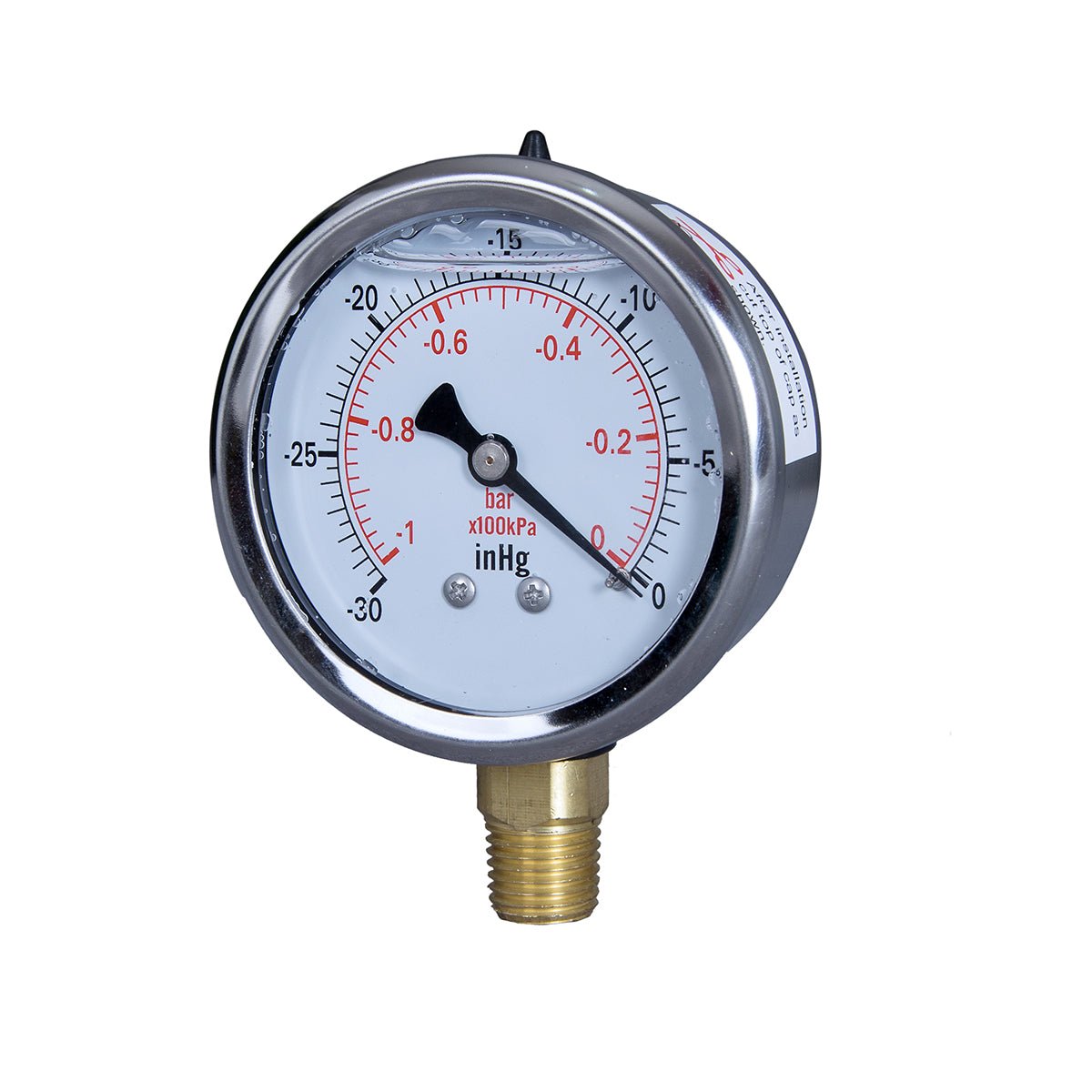
Fix 2 — Upgrade from dry to liquid filled. For residual vibration plus moderate pulsation, a glycerin-filled case is the standard cure: it damps the moving parts so the pointer settles readable and continuously lubricates the sector gear and pinion — the exact components that grind into filings under vibration. Two honest limitations: fill does not change calibration accuracy (that's set by movement quality and class rating), and glycerin service tops out around -20°C to +60°C — beyond that you need silicone fill. The sealed case also prevents the fogging that plagues dry gauges in humid or cold environments. Unsure whether the upgrade justifies its price? Our oil filled vs dry pressure gauge comparison shows when it pays for itself — and when a dry unit remains the smarter buy.
snubber vs liquid filled gauge
Fix 3 — Add a snubber for severe pulsation. Violent spikes from piston compressors or plunger pumps overwhelm fill fluid alone. A snubber screwed into the gauge socket throttles each surge before it reaches the tube (WIKA's snubber overview); combined with liquid fill it produces the steadiest readable needle available. Untreated severe pulsation eventually cracks tubes no matter what's in the case.
When a Jumping Needle Is a Warning, Not Just Noise
Most flutter is a readability and equipment-life problem, but certain needle behavior demands shutdown, not damping:
- Erratic violent swings unrelated to machine rhythm can indicate cavitation — collapsing vapor bubbles that destroy pump impellers.
- Sudden drops toward zero followed by snapping back suggest water hammer shockwaves, which split pipes and fittings.
- Progressive sag during operation, where peak readings decay run after run, points to a failing discharge or relief valve.
A properly damped gauge makes these dangers more visible: once routine flutter is smoothed out, a genuine abnormal event stands out instead of hiding in the noise. Treat unexplained needle behavior as data, not decoration.
Stop the Jumping at the Source: JIVTO Liquid Filled Pressure Gauges
JIVTO manufactures both dry and liquid filled gauges in Wenzhou, China, with over 15 years of production experience — so this recommendation comes from building and disassembling both types daily. Our 2" and 2.5" liquid pressure gauges are glycerin filled with 1/4" NPT lower or back mount connections, built for pump, compressor, and hydraulic duty where needles otherwise dance. The range-selection rule (steady ≤75%, cyclic ≤65% of full scale) is printed on our spec sheets so operators size correctly the first time.
To supply your distribution line or OEM program, Request a Quote directly: MOQ starts around 200 units, standard lead time is roughly 30 days after sample confirmation, and OEM/private-label branding is available.
Frequently Asked Questions
Why does my pressure gauge needle flutter only when the pump is running?
That's the classic pulsation fingerprint. The pump injects a pressure pulse on every stroke and the gauge displays each one. Confirm by shutting the pump down with the line still pressurized — an instantly still needle means the mechanism is fine; the fix is damping (liquid fill), plus a snubber for severe cases.
Does a liquid filled gauge read more accurately than a dry one?
No. Fill fluid damps pointer motion and lubricates the movement; it does not change calibration accuracy. Accuracy comes from movement quality and class rating — identical across comparable dry and filled models. Choose liquid fill for readability and movement life, not precision.
My needle jumps even when the system is completely off. What does that mean?
With the line depressurized, needle movement is environmental — nearby machinery shaking the mount. With the line holding pressure, a wandering needle usually means a slow leak or a worn movement sticking and releasing. The tee-in-a-second-gauge test separates the two.
Can I convert my existing dry gauge to liquid filled myself?
Don't. Proper filling requires evacuating the case under vacuum so glycerin displaces every air pocket, then permanently sealing the fill plug. A shop-made fill leaves trapped air that defeats damping and a seal that commonly weeps. Swap in a factory-filled gauge instead — and remember glycerin's roughly -20°C to +60°C service window when selecting for hot or freezing sites.
Conclusion: Read the Needle, Then Fix the Right Thing
A jumping needle is a diagnostic clue, not a random fault. Feel the case, watch it under static pressure, tee in a second gauge, and sync motion to machine speed — four steps that identify the cause in minutes. Then climb the fix ladder: remount first, liquid fill next, snubber for the worst pulsation. And when the pattern is erratic rather than rhythmic, stop the equipment before you stop the needle.
For equipment-specific recommendations, continue with best pressure gauge for air compressor, or return to the complete buyer's guide to match dial size, mount, and range before ordering.