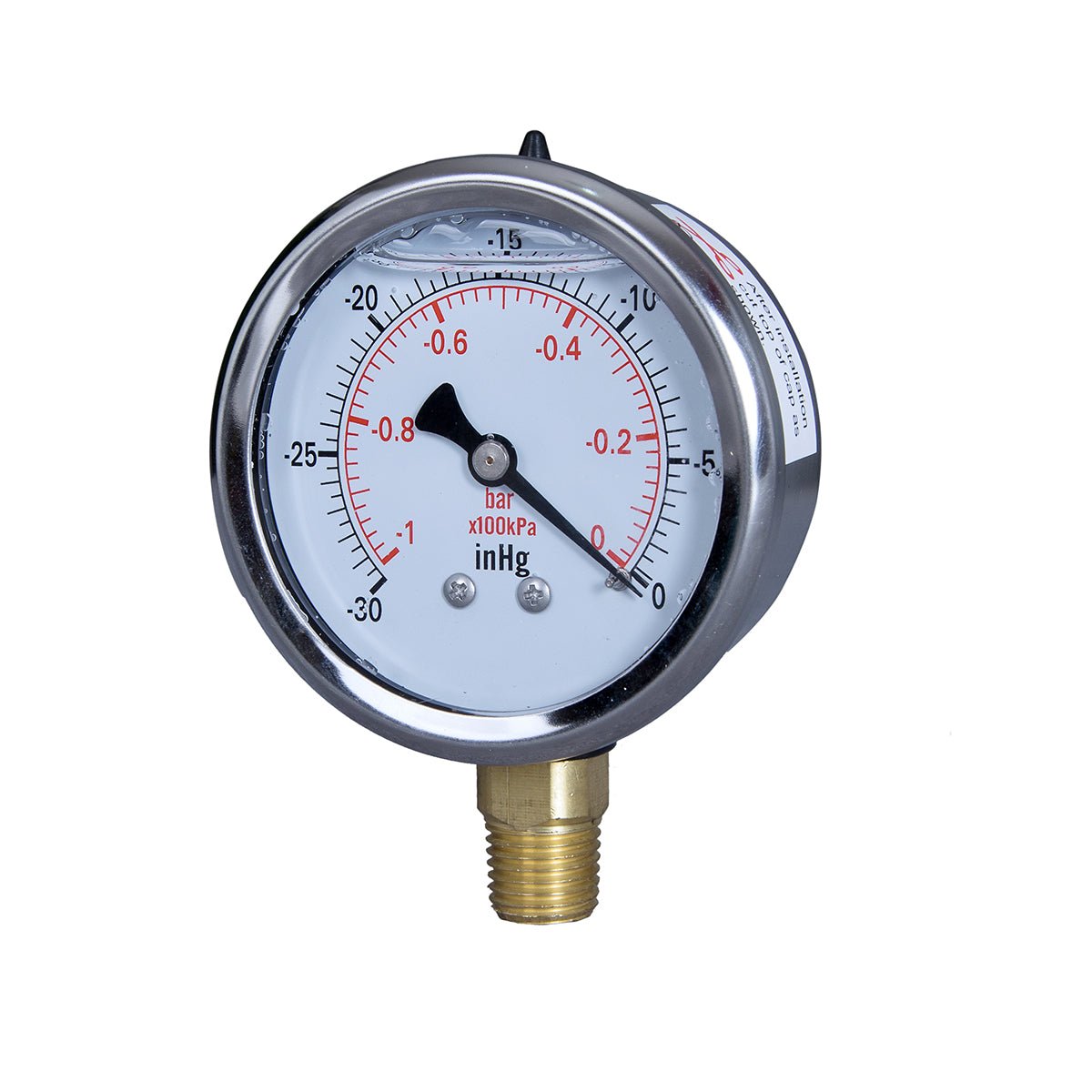
Pressure Gauge Snubber vs Liquid Filled Gauge: Which Stops Pulsation?
JIVTOShort answer: they solve two different problems, and hard-duty lines usually need both. A liquid filled gauge protects against vibration and moderate pressure ripple by damping the pointer itself. A snubber — sometimes a needle valve acting as a gauge protector — attacks severe pulsation by throttling the pressure waves before they ever reach the gauge port; Manogauge defines the device as a flow restriction, porous element, piston device, or adjustable needle arrangement used for exactly this pulsation reduction (Manogauge's snubber guide). On reciprocating pump lines and compressor discharges, fill fluid alone still fails; adding a snubber in front of the gauge is the standard fix we specify for OEM customers.
Below: the physics behind that split, a side-by-side table of every damping option, severity-based selection rules, and the maintenance catch most buyers find too late. New to liquid filling? Start with our complete liquid filled pressure gauge buyer's guide first.

Key Takeaways
- Fill fluid damps pointer motion — the right fix for panel vibration plus moderate ripple from gear pumps and fast valve cycling.
- A snubber reduces the pressure waves themselves at the gauge port — the fix for severe pulsation from piston pumps, compressor discharge, and water hammer.
- Match the fix to severity: mild duty → fill only; moderate duty → fill plus a socket restrictor; severe duty → fill plus an external snubber or needle valve.
- Snubbers throttle flow, so readings respond slower and the element can clog in dirty media — mount one where it can be reached and serviced.
Vibration and Pulsation Are Two Different Enemies
Most "my gauge died again" stories conflate two separate mechanisms, and choosing the wrong fix follows directly from that confusion.
Vibration is mechanical shake of the entire gauge — a diesel engine panel, a compressor skid, a mobile chassis rattling the whole instrument — attacking the movement's gears and pivots regardless of how smooth the pressure is.
Pulsation is rapid pressure fluctuation in the media itself. Reciprocating pumps displace discrete pockets of fluid per piston stroke, compressors surge on every cycle, and quickly cycling valves send sharp spikes down the line. Even a bolt-solid, motionless gauge gets flogged by this — each pulse flexes the Bourdon tube and hammers the pointer across the dial hundreds of times per minute. Failure-mode guides treat these as separate damage paths: constant vibration driving pointer oscillation and mechanical wear, pulsation fatiguing internal parts until a snubber or restrictor steps in (Valley Industries).
Here's the key distinction for choosing protection: fill fluid works on the pointer side; a snubber works on the media side. Glycerin fill resists rapid pointer motion and lubricates the movement, so it absorbs shake and takes the edge off moderate ripple — cushioning the movement and smoothing pointer response under pulsation (Mid-West Instrument). But the raw pressure waves still enter the Bourdon tube unchanged. A snubber sits upstream at the port and physically restricts how much of each wave reaches the tube at all. One calms what the needle does; the other calms what arrives at the instrument.
What Each Protection Option Actually Does
| Solution | Acts on | Best against | Trade-offs |
|---|---|---|---|
| Liquid fill (glycerin/silicone) | Pointer motion | Vibration + moderate ripple | Fills don't stop wave energy entering the tube; glycerin limits below ~60 °C / high heat needs silicone |
| Socket restrictor (built-in) | Media at the port | Mild-to-moderate pulsation | Cheapest option, factory-installed; fixed orifice, no tuning |
| Porous snubber | Media at the port | Steady, severe pulsation in clean media | Sinters fine pores — clogs first in dirty media |
| Piston snubber | Media at the port | Severe pulsation with dirty or viscous media | Tolerates debris better; still needs occasional cleaning |
| Adjustable snubber / needle valve | Media at the port | Severe pulsation where response time matters | Field-tunable damping; can drift out of adjustment under vibration |
Three of the five options live at the port, not in the case, because once severe pulsation exists nothing inside the gauge can undo it — throttle the waves or accept accelerated wear. A needle valve used for pulsation control works like a fixed snubber with tunability, which cuts both ways: overtightened, it also hides real pressure changes you needed to see.
Matching the Fix to Severity: Mild, Moderate, Severe
Severity — not budget — should drive the choice. Three tiers cover nearly every application we ship into.
Mild: vibration-dominated, steady pressure. Panels shaken by engines or fans but fed by centrifugal pumps or accumulators produce little genuine ripple. A quality liquid filled gauge alone is sufficient — fill absorbs the shake and small residual flutter. A snubber here buys only sluggish response.
Moderate: continuous visible flutter at pump frequency. Gear-pump hydraulic circuits and fast-cycling valve lines fall here. The pointer trembles constantly but tracks a readable average. Fill fluid remains the foundation, and pairing it with an inexpensive socket restrictor at the port typically settles the remaining ripple. We cover this tier in depth — including range selection and tap placement — in our guide to the liquid filled hydraulic pressure gauge, where pump ripple is a daily reality rather than an edge case.
Severe: piston pumps, compressor discharge, water hammer risk. Plunger and piston pumps generate pulses large enough to slam the pointer against the stops; quick-closing valves send shock waves down the line. This is where fill-only installations fail repeatedly — the fluid slows the pointer, but the Bourdon tube still takes the full hammering, and fatigue cracks follow. Severe duty calls for fill plus an external snubber or needle valve upstream of the gauge.

Our shop-floor rule: when a pump-set OEM reports repeated movement failures despite switching to filled cases, the root cause is almost always severe pulsation the fill was never designed to stop. Our first recommendation is a snubber ahead of the gauge — it resolves the majority of these cases without touching anything else on the line.
Why the Best Harsh-Line Setup Is Often Both
Fill and snubber aren't competitors; they're complementary layers aimed at different stages of the damage chain. A typical combination on a piston-pump line looks like this:
- Snubber or needle valve threaded into the process port, throttling the pressure waves before they propagate further.
- Short, solid connection between snubber and gauge — long thin tubing adds its own lag and resonance.
- Liquid filled case handling whatever vibration the mounting panel contributes and smoothing the residual ripple that slips past the restrictor.
Each layer covers the other's weakness. The snubber can't help with mechanical shake; the fill can't stop tube fatigue from raw spikes. Together they address both, which is why combination setups are common best practice on harsh lines rather than an upsell.
One honest trade-off: every restriction slows response, so a heavily damped setup won't chase fast transients — a brief surge may pass unregistered. If catching short-lived peaks matters, use an adjustable snubber or needle valve tuned as open as possible while still protecting the instrument, then document the setting.
The Maintenance Catch: Snubbers Clog
A snubber is a deliberate bottleneck, and bottlenecks collect whatever the media carries. Porous sintered types clog first in dirty or crystallizing fluids; piston types tolerate contamination better but still need periodic cleaning. Two practices prevent the silent failure mode:
- Install for service access. A snubber buried behind piping will eventually clog and leave the gauge showing a plausible frozen value while actual pressure has changed.
- Verify response during routine checks. Make a small process change and confirm the needle follows with its normal slight lag — a needle that never moves points at a blocked element, not a calm process.
Build the snubber into your PM schedule like a filter — it does filter-like work.
Getting the Right Protection Combination for Your Line
JIVTO manufactures liquid filled gauges as the foundation of any vibration or ripple problem — that part of the fix comes straight off our production line in Wenzhou, in glycerin and silicone fill, bottom and back entry, and ranges matched to your working pressure. Because we also supply instrument valves and ball valves, we can honestly recommend the combination when your application demands it: filled gauge plus snubber or needle valve sized to the line, rather than pushing a single product at every problem.
If your gauges keep failing on a piston pump, compressor, or hammer-prone line even after switching to liquid fill, tell us the media, pressure range, and pulse source — our engineers will specify the matching protection stack. Contact JIVTO through the website and request a quote for a gauge-and-snubber package built for your duty.
Frequently Asked Questions
Can't I just use a liquid filled gauge instead of installing a snubber?
Not when pulsation is severe. Fill fluid damps the pointer and lubricates the movement, but the full pressure waves still enter and flex the Bourdon tube — and on piston pumps and compressor discharges, that repeated flexing causes fatigue failure even inside a perfectly filled case. Severe pulsation needs a restriction at the port.
Is a needle valve the same thing as a snubber?
They work on the same principle — throttling flow to soften pressure spikes reaching the gauge. A snubber is typically a fixed element (porous disc, piston, or calibrated orifice) that needs no adjustment; a needle valve gives you a variable orifice you can tune in the field. Needle valve pulsation control suits lines where duty changes seasonally, but the adjustment can drift under vibration, so lock or check it periodically.
Where exactly should a snubber be installed?
Directly at the gauge connection point: thread the snubber into the process port or isolation valve, then mount the gauge onto the snubber outlet. Keep the assembly upright and compact, and place it where a technician can remove and clean it without shutting down half the plant. Never install it at the end of a long dead-leg where trapped fluid goes stagnant.
Won't a snubber make my pressure readings inaccurate?
It adds intentional lag, not error. The needle will read the true average pressure but respond slowly to rapid changes — that's precisely how it protects the movement. If tracking fast transients genuinely matters, use an adjustable snubber tuned for your transient window, and treat the damped reading as a trend indication rather than a peak recorder.
Bottom Line
Fill fluid and snubbers fail for different reasons on different problems. Diagnose first: shake of the case points to liquid fill; slam of the pointer from the media points to a snubber or needle valve; most punishing pump lines point to both installed together. Size the combination to your severity tier, give the snubber a serviceable home, and your gauge will finally outlast the maintenance cycle instead of becoming its most frequent line item.
When you're ready to spec it, review the full liquid filled pressure gauge selection criteria and contact JIVTO for a paired gauge-and-protection quote.