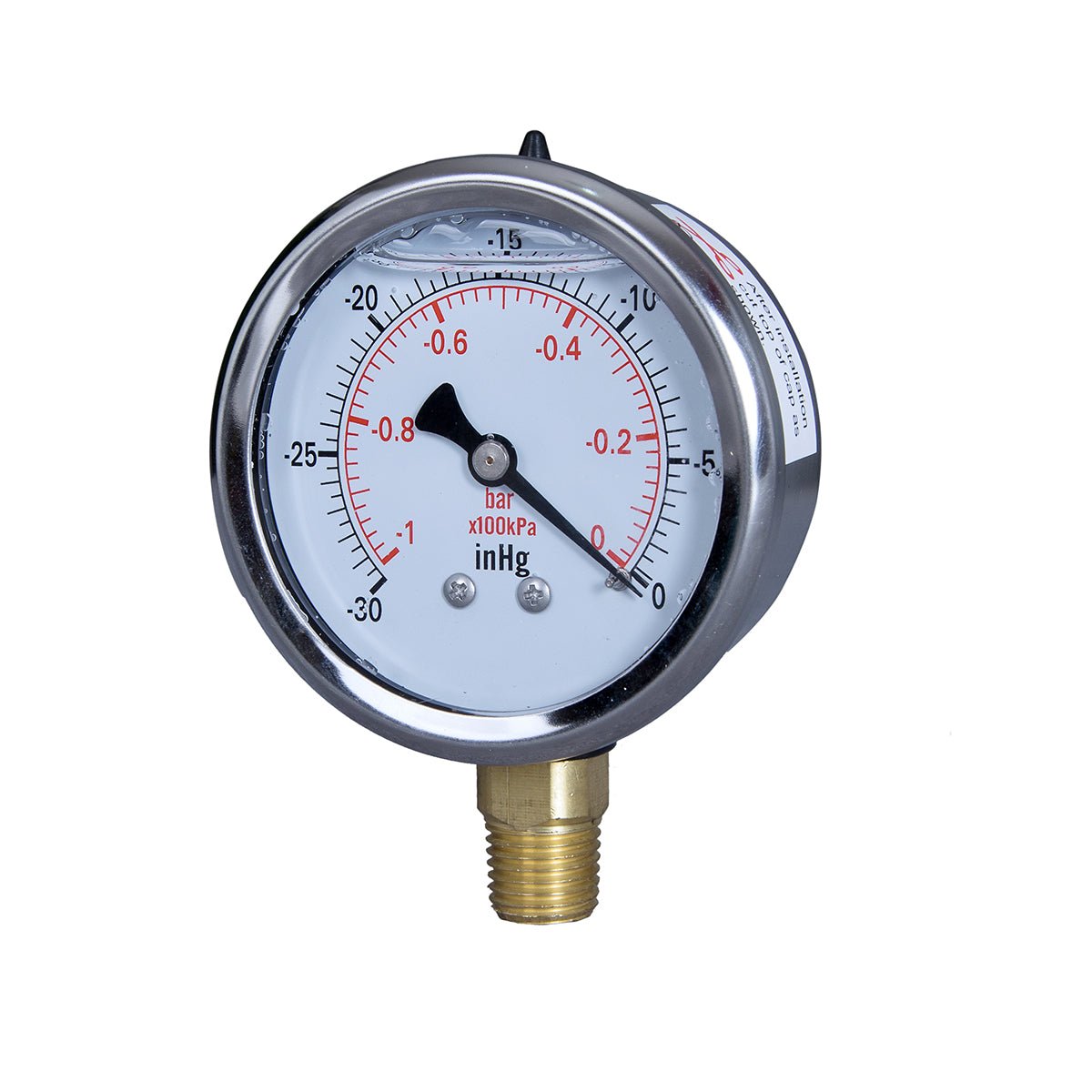
How to Read Pressure Gauge Specifications: Decode Any Spec Sheet (2026)
JIVTOA pressure gauge spec sheet is six fields in disguise: dial size, connection thread, mount position, pressure range, accuracy class, and case construction. Parse those six fields and any listing — ours or a competitor's — becomes readable in seconds. Below, we decode each field with mini-tables, then read a full listing line by line.
Here's the line we'll learn to read, taken from an actual JIVTO offer sheet sent to importers:
JIVTO 2.5″ Liquid Pressure Gauge – 1/4″ NPT lower mount, glycerin filled, dual scale psi/bar, Class 1.6
If that string reads as jargon, you're who this article is for. If you haven't yet chosen between liquid filled and dry types, start with our complete liquid filled pressure gauge buyer's guide first — this post assumes you've picked the category and need the exact model.

Key Takeaways
- Every gauge spec line contains six fields: dial size, connection size/type, mount position, range and scale units, accuracy class, and fill/case materials.
- Accuracy class means ±% of full span, not of reading. Class 1.6 on a 0–160 psi gauge is ±2.56 psi anywhere on the scale.
- Size the range so normal operation sits in the middle third (~25–75% of full scale); hold steady loads at or below 75% and cyclic loads at or below 65%.
- Once you can decode specs fluently, competing quotes become directly comparable — which is the whole point of learning this vocabulary before you buy.
The Six Fields That Matter on Every Pressure Gauge Spec Sheet
Manufacturers abbreviate because offer sheets travel by email, screenshot, and print — shorter lines mean fewer transcription errors. But the compression hides structure. Here is the JIVTO sentence exploded into its six fields:
| # | Field | Fragment | Question it answers |
|---|---|---|---|
| 1 | Dial size | 2.5″ | How far away will you read it? |
| 2 | Connection type + size | 1/4″ NPT | Will it screw into your port? |
| 3 | Mount position | Lower mount | Which way does the stem enter? |
| 4 | Range + scale units | Dual scale psi/bar | What pressures does it cover? |
| 5 | Accuracy class | Class 1.6 | How wrong can it be? |
| 6 | Fill + case materials | Liquid (glycerin filled) | Will it survive the environment? |
Any quote missing one of these six isn't a quote yet — ask the supplier to complete it before comparing prices.
Field 1: Dial Size — Match the Gauge to Viewing Distance
Dial size leads most listings because it drives both readability and price. Bigger dials show longer graduations and roomier numerals — useful only if someone stands far enough away to notice.
| Dial size | Metric | Best for |
|---|---|---|
| 2″ | 50 mm | Compact panels, tight manifolds, OEM equipment |
| 2.5″ | 63 mm | General service — the most common industrial size worldwide |
| 4″ | 100 mm | Distance reading across a plant floor |
Our rule of thumb: buy the smallest dial that stays readable at the gauge's real mounting distance. A 4″ face on a compressor two steps from the operator wastes money; a 2″ face on a header across the warehouse makes people squint — and squinting operators stop checking gauges.

Field 2: Connection Size and Mount — Get the Thread Right or It Won't Install
Connection specs carry two decisions: thread standard and mount position. Both are installation choices, not performance choices — but either one wrong makes the gauge unusable on arrival.
Thread standard. 1/4″ NPT is the American tapered pipe thread, dominant in North America (WIKA). 1/4″ BSPT (or parallel BSP) is the international equivalent across Europe, Asia, and most export markets; small 2″ gauges sometimes drop to 1/8″ NPT. The two have different thread angles — they may mesh a turn or two and feel tight, then weep under pressure. Specify what your port actually has.
Mount position. Lower mount = stem enters at the bottom (six o'clock), the default for inline piping. Back mount = stem enters at the rear of the dial, the choice for panel installs where the case sits flush through a cutout. Movement, accuracy, and function are identical; only plumbing geometry changes. For install geometry in depth, see our upcoming bottom mount vs back mount pressure gauge.
Field 3: Range Selection — Keep the Needle in the Middle Third
One rule governs range selection: normal operating pressure should sit in the middle third of the scale, roughly 25–75% of full scale. Bourdon tubes fatigue fastest near their elastic limits, and pointers pinned near the top lose both resolution and lifespan.
Two refinements from our production floor:
- Steady loads: keep maximum operating pressure at or below 75% of full scale.
- Cyclic loads (piston pumps, compressors): keep it at or below 65%, because spikes repeatedly push toward the tube's limit.
So a hydraulic circuit running steadily at 90 psi wants a 0–160 psi gauge (56%, comfortably mid-scale) — not the tempting 0–100 psi gauge that pins the needle at 90%.
The "dual scale psi/bar" fragment means one dial carries two concentric printed scales — psi outer, bar inner. One sensing element, two ways to read it; it costs almost nothing at the factory and saves international teams mental arithmetic.
Field 4: Gauge Accuracy Class Explained — ±1.6% of What?
Accuracy class is the most quoted and most misunderstood field on the sheet. Under EN 837-1 (mirrored in spirit by ASME B40.100 grade conventions), the class number states maximum permissible error as a percentage of the full scale span — never of the reading (Manogauge).
Work the example: Class 1.6 on a 0–160 psi gauge allows up to ±1.6% × 160 = ±2.56 psi anywhere on the dial — at 20 psi, at 80 psi, at 155 psi. Mid-scale that's trivial (~3% of reading); at a 25 psi reading it exceeds 10% of what the operator sees.
Three practical consequences:
- Don't over-buy range. A 0–1000 psi gauge reading a 50 psi line can legally be off ±16 psi — a better class wouldn't fix what a sensible range would.
- Class 1.6 is the quality general-service standard. Class 2.5 marks economy; classes 1.0 and 0.6 belong on test benches.
- Compare classes across quotes. Two identically priced gauges specced Class 2.5 versus Class 1.6 are not the same product.
Fields 5 and 6: Fill Fluid and Case Materials
The final fragments describe survivability. Fill fluid ("glycerin filled") signals the vibration-damped version of the same base gauge — the sealed bath quiets pointer flutter on pumps and compressors and lubricates the gear train under cyclic load. It changes neither range nor calibration. If your medium or climate rules out glycerin, our glycerin vs silicone fill comparison covers the trade-offs.
Case materials split two ways. Painted steel cases suit benign indoor panels; stainless earns its premium in wash-down, marine, chemical, and outdoor service. Polycarbonate (PC) windows resist impact; glass resists scratching. A quote saying only "liquid filled, 2.5″" without case material is hiding its cheapest component.
Worked Example: Decoding the Full Listing Line by Line
Back to the original sentence — you can now read every token:
| Token | Field | Decoded meaning |
|---|---|---|
| JIVTO | Brand | Factory-direct maker, Yueqing Jintu Trading Co., Wenzhou, China |
| 2.5″ | Dial size | 63 mm general-service face, readable to several meters |
| Liquid Pressure Gauge | Fill | Glycerin-damped for vibrating installs |
| 1/4″ NPT | Connection | US taper thread, fits standard 1/4″ ports |
| Lower mount | Mount | Bottom-entry stem for inline piping |
| Dual scale psi/bar | Range/scale | One dial, paired imperial and metric scales |
| Class 1.6 | Accuracy | ±1.6% of full span (EN 837-1 conventions) |
Notice what's still absent: the numeric range (0–? psi) and case/window materials — exactly the two clarifications we ask importers to pin down first.
Three Common Misreads That Cost Buyers Money
Misread 1: Treating accuracy class as "% of reading"
The costliest confusion in gauge procurement. Class 1.6 does not mean each reading is within 1.6% — the ceiling is 1.6% of full span, everywhere on the scale (GNW Shop). Relative error explodes near the low end, which is why range selection beats chasing a better class.
Misread 2: Assuming "dual scale" means two gauges or two calibrations
Dual scale is printing, not hardware: one Bourdon tube, one movement, one calibration, two engraved rings. A "psi version" and a "bar version" are the same part.
Misread 3: Believing mount position changes performance
Lower and back mount housings carry identical movements and accuracy classes. The distinction is purely plumbing: inline lines take lower entry, panels take rear entry. Choosing wrong doesn't degrade readings — it strands you with a gauge that won't fit the hole you drilled.
Pre-Quote Checklist: Six Boxes Before You Request Prices
Run this against your requirement before sending it to any factory:
- [ ] Dial size chosen for actual viewing distance (2″ compact / 2.5″ general / 4″ remote)
- [ ] Thread standard matches the port: 1/4″ NPT (US) or 1/4″ BSPT/BSP (international)
- [ ] Mount position matches the install: lower mount inline, back mount panel
- [ ] Range sized so operating pressure lands at 25–75% of scale (≤65% if cyclic)
- [ ] Accuracy class appropriate: Class 1.6 general service, 2.5 economy, 1.0 or better for test use
- [ ] Fill and case matched to environment: glycerin if vibration exists; stainless if wash-down, marine, or outdoor
A requirement that passes all six boxes produces quotes you can rank on price alone. That comparability is why we teach this: when every bidder answers in the same vocabulary, sourcing shifts from guesswork to arithmetic, and the wholesale liquid filled pressure gauge supplier checklist becomes a ten-minute exercise instead of a week of emails.
Ready to try it? Send JIVTO your current spec line — or just your six checklist answers — and request a quote. We'll return an offer sheet written in exactly the vocabulary you now read fluently.
Frequently Asked Questions
What does Class 1.6 mean on a pressure gauge?
That the maximum permissible error is ±1.6% of the full scale span, per EN 837-1 accuracy-class conventions. On a 0–160 psi gauge, that's ±2.56 psi at any point on the dial. Class 2.5 denotes the economy tier (±2.5% of span); classes 1.0 and 0.6 serve test and calibration work.
Is 1/4″ NPT the same as 1/4″ BSPT?
No. They share a nominal size but differ in thread angle — NPT uses a 60° form, BSPT a 55° form. They can mesh partway and feel snug, then leak under pressure. Order the standard matching your port and market: NPT for North American equipment, BSPT/BSP for most international installations.
What dial size do I need for a pressure gauge?
Choose by viewing distance: 2.5″ (63 mm) is the global general-service default; 2″ (50 mm) suits cramped panels and OEM builds; 4″ (100 mm) serves long-distance reading from an operator station. Buy the smallest dial that stays legible where people actually stand.
Does glycerin filling change a gauge's accuracy or range?
No. Fill fluid damps pointer vibration, protects the movement from wear, and prevents window fogging — but the Bourdon tube, calibration, and rated range are identical to the dry version of the same model. Fill is an environmental upgrade, not a metrological one.