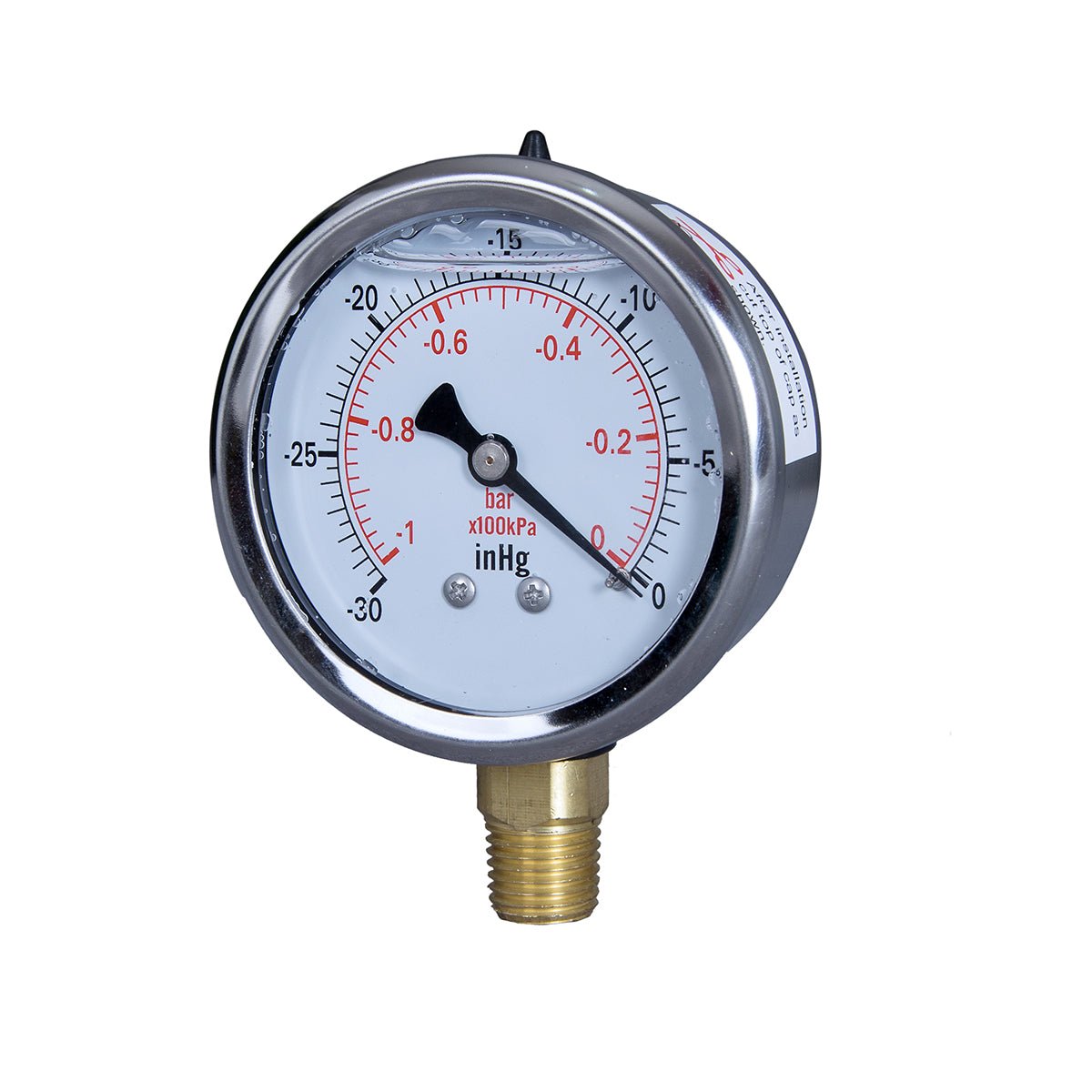
Types of Pressure Gauges Explained (2026)
David ZhengA failed pressure gauge does not just give a wrong reading. It can shut down a production line, compromise product quality, or create a safety hazard. Yet most buyers spend more time choosing a light bulb than selecting the right pressure gauge. With Bourdon tube, diaphragm, digital, capsule, and specialized gauges available, matching the right technology to your application is not always straightforward.
By the end of this guide, you will understand every major pressure gauge type, how to select the right one using the STAMPED framework, and how to get custom gauges manufactured for your specific needs. Whether you are an engineer specifying equipment for a chemical plant or a purchasing manager sourcing gauges for a new product line, this guide gives you the working knowledge to make confident decisions.
[INTERNAL-LINK: pressure gauge basics → what is a pressure gauge]
TL;DR
Pressure gauges measure gas or liquid pressure in PSI, bar, or kPa. The three main technologies are Bourdon tube (general-purpose, high pressure), diaphragm (corrosive/sanitary media, low pressure), and digital (high accuracy, data logging). Always apply the middle-third rule: select a gauge with a full-scale range double your normal operating pressure. The global pressure gauge market is valued at roughly $954 million to $2.94 billion depending on market definition, growing at 2.5 to 4.9 percent CAGR. For custom or OEM requirements, manufacturers like JIVTO offer full customization options with 15 years of production expertise.
[INTERNAL-LINK: pressure gauge selection guide → how to choose the right gauge]
What Is a Pressure Gauge? Definition and Basic Working Principle
Not sure yet whether you need a Bourdon tube, a diaphragm, or something else entirely? Our plain-English primer on what a pressure gauge is and how it works explains the operating principles behind every technology covered below.
A pressure gauge is an instrument that measures the force exerted by a gas or liquid per unit area within a sealed system, typically displayed in PSI, bar, or kPa. The gauge converts physical pressure into a readable mechanical or electrical signal.
How Pressure Measurement Works
All pressure gauges operate on the same principle: a sensing element deforms under applied pressure, and that deformation is translated into a reading. In mechanical gauges, the deformation moves a pointer across a dial. In digital gauges, a sensor converts the deformation into an electrical signal displayed on an LCD or LED screen.
Pressure Measurement Units
Three units dominate the industry:
- PSI (pounds per square inch): Standard in the United States and for many hydraulic and pneumatic systems globally.
- Bar: Common in European and Asian industrial applications. One bar equals approximately 14.5 PSI.
- kPa (kilopascal): The SI unit, widely used in scientific and HVAC applications. 100 kPa equals 1 bar.
The Four Pressure References
Not all pressure measurements are the same. The reference point changes what the reading means:
- Gauge pressure (psig): Measures pressure relative to local atmospheric pressure. A tire pressure gauge reads gauge pressure. This is the most common reference in industrial applications.
- Absolute pressure (psia): Measures pressure relative to perfect vacuum. Used in altimetry, vacuum systems, and meteorological applications.
- Differential pressure: Measures the difference between two points. Used for filter monitoring, flow measurement, and leak detection.
- Sealed gauge pressure: Measures pressure relative to a fixed sealed reference, not open to atmosphere. Used in high-altitude or variable-atmosphere conditions.
Market Context
The global pressure gauge market was valued at approximately $954 million in 2025 according to IMARC Group, with projections reaching $1.20 billion by 2034 at a compound annual growth rate (CAGR) of 2.51 percent. A broader market definition from 360iResearch places the 2025 value at $2.94 billion, growing to $4.11 billion by 2032 at a 4.90 percent CAGR. The difference reflects whether adjacent products like transmitters and switches are included. Both estimates confirm steady, sustained demand driven by industrial expansion and infrastructure investment.
Regionally, Asia-Pacific holds more than 30.5 percent of the global market share (IMARC Group, 2025), with China's industrial pressure measurement segment growing at an 8.5 percent CAGR (360iResearch, 2025-2032). This growth reflects the region's manufacturing and energy sector expansion.
The Main Types of Pressure Gauges by Technology
Pressure gauges fall into two broad technology families: mechanical (analog) and digital. Each family contains distinct subtypes optimized for specific pressure ranges, media types, and operating environments.
Bourdon Tube Gauges
The Bourdon tube gauge is the most common type of pressure gauge in industrial use. A curved tube (C-shaped, helical, or spiral) straightens under pressure and moves a linkage that rotates a pointer.
- Pressure range: 0.6 to 7,000 bar (approximately 10 to 100,000 PSI)
- Accuracy: ASME Grade 1A (1.0% FS) to Grade A (0.5% FS) in standard configurations
- Best for: General industrial, hydraulic, pneumatic, and high-pressure applications
- Limitations: Not ideal for highly viscous or crystallizing media that could clog the tube entry
[IMAGE: Bourdon tube gauge internal mechanism diagram - search terms "Bourdon tube pressure gauge internal parts C-shaped tube"]

The Bourdon tube gauge segment was valued at $2.09 billion in 2025 according to GII Research, with a projected CAGR of 8.49 percent to reach $3.71 billion by 2032. This growth outpaces the overall gauge market, driven by replacement demand in oil and gas, chemical processing, and power generation.
When to choose a Bourdon tube gauge: You need a general-purpose, cost-effective solution for clean liquids or gases at moderate to high pressures. It is the default choice for 80 percent of industrial applications.
Diaphragm Gauges
A diaphragm gauge uses a flexible membrane that deflects under pressure. The deflection is transmitted mechanically to a pointer or electrically to a sensor.
- Pressure range: 0-25 mbar to 0-40 bar (approximately 0.4 to 580 PSI)
- Best for: Corrosive, viscous, crystallizing, or sanitary media
- Key advantage: The diaphragm isolates the internal mechanism from the process media, protecting the movement from damage
Diaphragm gauges excel where Bourdon tube gauges fail. If you are measuring pressure in a slurry, a corrosive chemical, or a food product requiring sanitary conditions, a diaphragm gauge is the correct choice. The diaphragm can be coated with PTFE, Hastelloy, or other chemically resistant materials.
When to choose a diaphragm gauge: Your media is corrosive, contains suspended solids, or requires sanitary compliance (3-A, FDA). Also ideal for low-pressure ranges below 10 bar where Bourdon tube sensitivity is insufficient.
Capsule and Bellows Gauges
Capsule and bellows gauges use stacked or pleated membranes for ultra-low pressure measurement.
- Pressure range: 0-25 mbar to 0-600 mbar (approximately 0.4 to 8.7 PSI)
- Best for: HVAC duct static pressure, leak detection, medical respirators, gas burners
- How they work: A capsule element consists of two concentric diaphragms welded together. Bellows elements are accordion-like structures that expand or contract with pressure changes.
These gauges are highly specialized. You will find them monitoring draft pressure in industrial chimneys, verifying filter cleanliness in HVAC systems, and measuring low gas pressures in medical equipment.
When to choose a capsule or bellows gauge: Your application involves very low gas pressure, typically below 1 PSI, where even a diaphragm gauge lacks sufficient resolution.
Digital Pressure Gauges
Digital gauges use electronic pressure sensors: piezoresistive, capacitive, or resonant silicon. The sensor output is processed by a microcontroller and displayed on a digital readout.
- Pressure range: 0-1 bar to 0-10,000 bar, depending on sensor type
- Accuracy: 0.05 to 0.25 percent of full scale (FS)
- Best for: High precision, data logging, remote monitoring, automation integration
- Features: Min/max recording, tare, unit conversion, alarm setpoints, digital communication (4-20 mA, Modbus, HART)
The digital pressure gauge market is growing at a 4.1 percent CAGR from 2026 to 2035 according to Expert Market Research, driven by industrial automation and IoT adoption. While digital gauges represent a smaller unit volume than analog, they capture increasing value in high-precision and networked applications.
When to choose a digital gauge: You need accuracy below 0.5 percent FS, data recording capability, or integration with a control system. Digital gauges are also preferred for test and calibration applications where readability and precision are critical.
[IMAGE: Digital pressure gauge on a test stand - search terms "digital pressure gauge calibration test stand industrial"]

Liquid-Filled Gauges
If pulsation, vibration, or outdoor moisture is your problem, jump to the complete guide to liquid-filled pressure gauges for fill-fluid comparisons and sizing rules — or browse the factory-direct liquid-filled range and compare models side by side.
A liquid-filled gauge contains glycerin, silicone oil, or halocarbon inside the case. The liquid dampens pointer flutter and cushions internal components against vibration and shock.
- Pressure range: Same as the underlying Bourdon tube or diaphragm mechanism
- Best for: Pumps, compressors, hydraulic systems, and any application with pressure pulsation or machine vibration
- Lifespan benefit: Liquid filling extends gauge service life by approximately 20 percent in dynamic environments (Source: FCI Tech Sheet)
The fill fluid serves two purposes: it lubricates the movement and it absorbs mechanical energy that would otherwise wear down pivot bearings and gear teeth. For applications with rapid pressure cycling, liquid fill is not optional. It is a reliability requirement.
When to choose a liquid-filled gauge: Your system has pressure pulsation, vibration, or rapid cycling. If the needle visibly oscillates during normal operation, you need a liquid-filled gauge.
Specialized Gauge Types
Several niche gauge types address specific industry requirements:
- Sanitary gauges: Designed for food, dairy, and pharmaceutical applications with 3-A or EHEDG certification. Feature flush diaphragms and tri-clamp connections for clean-in-place (CIP) compatibility.
- Test and calibration gauges: High-accuracy (0.1 to 0.25 percent FS) gauges used for verifying and calibrating working gauges in the field or lab.
- Ultra-high pressure gauges: Rated for 20,000 to 100,000 PSI. Used in water jet cutting, hydraulic presses, and high-pressure testing.
- Contact and switch gauges: Incorporate electrical contacts that trigger alarms or control actions at preset pressure points.
- Duplex gauges: Contain two independent measuring systems in one case, displaying both input and output pressure on a single dial.
- Boiler and refrigeration gauges: Application-specific designs meeting ASME boiler code or refrigeration safety standards.
Gauge Pressure vs Absolute Pressure vs Differential Pressure
The three pressure references answer different measurement questions. Choosing the wrong reference can lead to incorrect readings and potentially unsafe operating conditions.
Gauge pressure reads relative to local atmospheric pressure. When you check your car tire pressure, the gauge reads PSI relative to the air around you. At sea level, 0 PSIG equals approximately 14.7 PSIA. This is the reference used for most industrial pressure gauges because the systems they monitor operate above atmospheric pressure.
Absolute pressure reads relative to perfect vacuum. If you seal a gauge and evacuate all air from the reference chamber, the gauge reads absolute pressure. Absolute pressure readings are essential for:
- Barometric altimetry
- Vacuum furnace monitoring
- Vapor pressure measurement
- Any calculation involving the ideal gas law (PV = nRT)
Differential pressure reads the difference between two points. Two pressure ports connect to separate locations, and the gauge displays the delta. Applications include:
- Filter monitoring: A rising differential across a filter indicates clogging
- Flow measurement: Across an orifice plate, the differential pressure correlates to flow rate
- Level measurement: In sealed tanks, the differential between top and bottom ports indicates liquid level
Differential pressure measurement accounts for roughly 18 percent of industrial pressure measurement applications (industry estimate). It is far less common than gauge pressure but critically important in process control.
Practical guidance: When ordering a gauge, specify the reference. Most standard gauges are gauge pressure (PSIG). If you need absolute, the gauge must have a sealed or evacuated reference chamber. If you need differential, you need a gauge with two pressure ports. These are not interchangeable.
Digital vs Analog Pressure Gauges: Comparative Analysis
Digital gauges offer 5 to 50 times better accuracy than analog, but analog gauges cost less, require no power, and are more intuitive for quick visual checks. The right choice depends on what you value most in your specific application.
| Factor | Analog (Mechanical) | Digital |
|---|---|---|
| Accuracy | 1.0 to 2.5% FS (Grade 1A to Grade D) | 0.05 to 0.25% FS |
| Readability | Quick visual scan; parallax possible | Exact numeric; no guessing |
| Power needed | None | Battery or loop power |
| Data output | None | 4-20 mA, Modbus, HART, Bluetooth |
| Vibration resistance | Good (excellent with liquid fill) | Sensor stable; display may flicker |
| Temperature sensitivity | Moderate | Low to moderate (compensated) |
| Unit cost | Low to moderate | Moderate to high |
| Lifespan | 5-10 years typical | 3-7 years typical (battery-dependent) |
| Intrinsically safe options | Widely available | Available but more complex |
When to Choose Analog
Analog gauges remain the default for most industrial applications for good reasons. They are passive devices requiring no electrical power, meaning they fail only when the mechanical movement or sensing element breaks. In hazardous environments where intrinsic safety is a concern, an analog gauge is simpler to certify and deploy.
Choose analog when:
- Your accuracy requirement is 1.0 percent FS or less demanding
- The gauge is used for quick visual monitoring rather than precise data collection
- You need intrinsic safety certification without electronics
- Your operators rely on trend-reading (seeing needle position at a glance)
- Budget constraints favor the lower upfront cost
When to Choose Digital
Digital gauges are not a replacement for analog across the board. They are a specialized tool for applications where analog cannot meet the requirements.
Choose digital when:
- Your accuracy requirement exceeds 0.5 percent FS
- You need data logging, remote monitoring, or control system integration
- You perform test and calibration work requiring high precision
- Your application benefits from features like tare, min/max recall, or unit conversion
- Operator reading errors (parallax, misreading) present a risk
Real-World Examples
A hydraulic press operating at 3,000 PSI with a gauge reading used only for operator awareness: analog is the economical choice. A pharmaceutical reactor where pressure must stay within 0.5 PSI of a setpoint during a 12-hour batch: digital is the safer choice. The two technologies coexist because they serve different jobs.
Accuracy Classes Explained: ASME B40.100 Standards
Accuracy class is only one of the six fields that decide whether a gauge will work in your line. Our guide to reading any pressure gauge spec sheet walks through dial size, connection, range, and fill fluid in the order you meet them on a real datasheet.
Pressure gauge accuracy is expressed as a percentage of full scale (not of the reading). This distinction matters: a 1.0 percent FS gauge at a 100 PSI scale is accurate to within 1 PSI anywhere on the dial, whether the reading is 10 PSI or 90 PSI.
The ASME B40.100 standard defines accuracy grades from 4A (most accurate) to D (least accurate). Here is the full breakdown:
What Accuracy Do You Actually Need?
Many buyers overspecify accuracy. A Grade A (1.0 percent FS) gauge is sufficient for 70 percent of industrial applications including hydraulic systems, compressed air lines, and general process monitoring. Go to Grade 2A (0.5 percent FS) for tighter process control. Go to Grade 3A or 4A only for test, calibration, and critical process applications where the cost premium is justified.
Analog gauges typically deliver Grade A (1.0 percent FS) to Grade D (5.0 percent FS) accuracy depending on the mechanism and quality level. Digital gauges achieve Grade 3A (0.25 percent FS) or Grade 4A (0.10 percent FS). The difference is between seeing "roughly 100 PSI" and knowing "exactly 100.0 PSI."
[INTERNAL-LINK: ASME B40.100 accuracy standards → detailed accuracy class guide]
How to Select the Right Pressure Gauge: The STAMPED Framework
For a decision order you can follow step by step — range first, then connection, dial size, and accuracy — start with our how to select a pressure gauge walkthrough before you request quotes.
The STAMPED method covers every variable in pressure gauge selection. Use it as a checklist when specifying or purchasing gauges to avoid mismatches that cause early failure or inaccurate readings.
Size: Dial diameter ranges from 1.5 inches (40 mm) for portable equipment to 6 inches (150 mm) for panel-mounted gauges in control rooms. Larger dials improve readability at a distance. For most industrial applications, 4-inch (100 mm) is the standard.
Temperature: Ambient and process temperature affect gauge performance. Standard gauges are rated for -40 F to 160 F (-40 C to 71 C). High-temperature models with isolation siphons or diaphragm seals handle up to 600 F (315 C). For every 20 F above rated temperature, expect accuracy to decline by approximately 1 percent.
Application: Understand the operating cycle. Is the pressure steady, pulsating, or cycling rapidly? Steady service allows standard dry gauges. Pulsating or cycling service requires liquid fill or an isolation valve to dampen pressure spikes.
Media: The fluid in contact with the gauge determines wetted material requirements. Air, water, and hydraulic oil are safe with brass or 304 stainless steel. Corrosive chemicals demand 316 SS, Monel, Hastelloy, or PTFE coatings. Food and pharmaceutical applications require 316 SS with 3-A sanitary finish.
Pressure range: This is the most critical parameter. Select a gauge where the normal operating pressure falls in the middle third (25 to 75 percent) of the full-scale range. This is called the middle-third rule. If your system operates at 100 PSI, choose a 0-160 PSI or 0-200 PSI gauge. Never select a gauge where the operating pressure exceeds 75 percent of full scale, because sustained operation at the top of the range accelerates wear and reduces accuracy.
End connections: NPT (National Pipe Thread) is the standard in North America, available in 1/4 inch and 1/2 inch sizes for most applications. BSPT and BSPP are common globally. Ensure the connection material matches the media compatibility requirements. A 304 SS connection is standard for general use; 316 SS for corrosive environments.
Dial and safety features: Select dial markings in the units your operators read (PSI, bar, kPa, or dual scale). For safety, look for blow-out back or blow-out disc designs that relieve pressure if the Bourdon tube ruptures. For oxygen service, gauges must be oxygen-cleaned and labeled accordingly.
[CHART: SVG selection flowchart for STAMPED framework]
Media Compatibility Quick Reference
| Fluid Type | Recommended Wetted Material |
|---|---|
| Air, water, oil, non-corrosive gases | Brass or 304 stainless steel |
| Corrosive chemicals (acids, caustics) | 316 SS, Monel, Hastelloy |
| Food, dairy, pharmaceutical | 316 SS with 3-A sanitary finish |
| Strong acids (HCl, H2SO4) | Tantalum, PTFE-coated, Hastelloy C-276 |
| Seawater | Monel or 316 SS |
| Oxygen | Oxygen-cleaned 316 SS or brass (special cleaning cert) |
[INTERNAL-LINK: pressure gauge connection types → NPT, BSPT, BSPP explained] [INTERNAL-LINK: pressure gauge material selection guide → wetted materials comparison]
Common Industrial Applications for Pressure Gauges
HVAC and Refrigeration
Pressure gauges monitor refrigerant pressures on the high and low sides of compressors, verify duct static pressure for airflow balancing, and track boiler water pressure in hydronic systems. Capsule gauges are common for low-pressure duct monitoring, while Bourdon tube gauges handle refrigerant line pressures.
Oil and Gas
Upstream, midstream, and downstream operations rely on pressure gauges at every stage: wellhead pressure monitoring, pipeline transmission, refinery process vessels, and storage tank level indication. This sector demands robust gauges with high pressure ratings (up to 10,000 PSI or more) and materials compatible with sour gas (NACE MR0175 compliance).
[IMAGE: Oil and gas pressure gauge installation at a wellhead - search terms "oil gas pressure gauge wellhead industrial"]

[INTERNAL-LINK: industrial pressure gauge applications by industry → oil and gas specific guide]
Manufacturing and Hydraulics
Hydraulic presses, injection molding machines, stamping equipment, and automated production lines use pressure gauges to confirm system pressure stays within design limits. Liquid-filled gauges are standard here because hydraulic systems produce vibration and pressure spikes.
Food and Pharmaceutical
Sanitary pressure gauges with flush diaphragm designs and tri-clamp connections are required for processes involving food products, dairy, beverages, and pharmaceutical compounds. These gauges must withstand clean-in-place (CIP) and sterilize-in-place (SIP) cycles while maintaining sanitary surface finishes (Ra < 0.8 micrometers).
Water and Wastewater
Pressure gauges monitor pump discharge pressure, filter differential pressure, and distribution system pressure in municipal and industrial water treatment plants. Diaphragm gauges are common for sludge and slurry applications where solids would clog a Bourdon tube.
Medical Equipment
Pressure gauges are critical in medical gas delivery systems (oxygen, nitrous oxide, compressed air), ventilators, anesthesia machines, and hyperbaric chambers. These applications demand gauges with high accuracy, biocompatible wetted materials, and often digital outputs for integration with patient monitoring systems.
Pressure Gauge Maintenance, Calibration, and Replacement
Most industrial gauges require annual calibration, and typical lifespan is 5 to 10 years. But harsh environments with vibration, temperature extremes, corrosive media, or pressure cycling can reduce lifespan to 1 to 2 years (industry standard observations).
Calibration Schedule
The right calibration frequency depends on how critical the gauge is to your operation:
- Standard industrial gauges: Annual calibration against a reference standard (0.25 percent FS or better)
- Critical process gauges: Quarterly or monthly calibration, especially in pharmaceutical, food, and chemical applications where pressure tolerances directly affect product quality
- Test and calibration gauges: Before each use or at least every 3 months
- Safety-related gauges: Per local regulatory requirements (often quarterly for boiler and pressure vessel applications)
Common Failure Modes
Pressure gauges fail in predictable ways. Recognizing the symptoms saves replacement costs and prevents inaccurate readings:
- Pointer drift: The zero position shifts over time. Most common in older mechanical gauges. Correctable through recalibration if the movement is not worn.
- Broken or stuck pointer: Usually caused by overpressure, vibration fatigue, or media crystallization inside the Bourdon tube. Requires replacement.
- Case corrosion: Rust or pitting on the case indicates environmental moisture or chemical exposure. A stainless steel case with IP65 or higher rating is the solution.
- Lens fogging: Moisture inside the case indicates seal failure. Can damage the dial and movement. Use a glycerin-filled or dry-nitrogen-purged gauge for humid environments.
- Clogged connection port: Crystallized media, sludge, or debris blocking the pressure port. A diaphragm seal or chemical seal prevents this.
[INTERNAL-LINK: common reasons for pressure gauge failure → diagnosis and prevention] [INTERNAL-LINK: how to calibrate a pressure gauge → step-by-step calibration guide]
Replacement Indicators
Replace a gauge when:
- It fails calibration by more than the specified accuracy grade
- The pointer does not return to zero when depressurized
- The case is corroded or damaged
- The lens is cracked or fogged
- The connection is damaged or leaking
- The gauge has been exposed to overpressure exceeding 125 percent of full scale
Lifespan Extension
Liquid filling extends gauge service life by approximately 20 percent in dynamic environments (Source: FCI Tech Sheet). Other proven extensions include installing siphon tubes or diaphragm seals for high-temperature service, using vibration dampeners, and selecting cases with higher ingress protection (IP65/IP67) for outdoor or washdown environments.
OEM/ODM and Custom Pressure Gauges
For businesses requiring non-standard ranges, custom dial markings, private labeling, or specialized materials, OEM/ODM manufacturing offers a cost-effective solution. Off-the-shelf gauges cover perhaps 80 percent of applications. The remaining 20 percent demands customization.
When to Consider Custom Gauges
- Non-standard pressure range: Your application requires a range not available in standard product lines
- Custom dial markings: You need dual-scale (PSI/bar), special color zones, company logos, or custom unit labels
- Private labeling: You want to sell gauges under your own brand name
- Specialized materials: Your media requires wetted materials not available in standard configurations (e.g., Monel, Hastelloy, PTFE-lined)
- Unique connection: Your system uses non-standard thread sizes, flange connections, or custom seal configurations
- Integration requirements: The gauge must interface with existing control systems via specific electrical connections or communication protocols
What OEM/ODM Manufacturing Involves
When you order custom gauges, the manufacturer works from your specification sheet or from a discussion of your requirements. Typical steps include:
- Requirement gathering: Pressure range, accuracy, media, connection type, dial specifications, and quantity
- Material selection: Case material, wetted parts, fill fluid (if liquid-filled), gasket material
- Dial design: Artwork approval for custom markings, logos, and scale layout
- Prototype: For large orders, manufacturers typically produce samples for testing and approval
- Production: Batch manufacturing with quality control inspections at each stage
- Calibration and certification: Each gauge is calibrated and shipped with a certificate if required
[INTERNAL-LINK: custom OEM pressure gauges → complete OEM/ODM manufacturing guide] [INTERNAL-LINK: ordering custom pressure gauges → step-by-step ordering process]
Minimum Order Quantities
Custom orders generally require minimum quantities (MOQs) ranging from 50 to 500 pieces depending on complexity. Some manufacturers offer lower MOQs for simpler modifications like custom dial markings on standard mechanisms. Discuss MOQ early in the process to align with your budget and production timeline.
Frequently Asked Questions
What is the difference between gauge pressure and absolute pressure?
Gauge pressure measures pressure relative to local atmospheric pressure. When you read 0 PSIG on a tire gauge, the tire is at atmospheric pressure. Absolute pressure measures pressure relative to perfect vacuum. Absolute pressure equals gauge pressure plus atmospheric pressure (14.7 PSI at sea level). For sealed system monitoring, use gauge pressure. For calculations involving gas laws or vacuum measurement, use absolute pressure.
How often should a pressure gauge be calibrated?
Standard industrial pressure gauges should be calibrated annually against a reference standard with accuracy at least four times better than the gauge being tested. Critical process gauges in pharmaceutical, food, and chemical applications should be calibrated quarterly or monthly. Test and calibration gauges should be verified before each use. These frequencies follow established industry practice and are consistent with ISO 10012 and other quality management standards.
Can I use a pressure gauge for both liquids and gases?
Yes, most pressure gauges work with both liquids and gases. The same Bourdon tube mechanism responds to pressure regardless of the fluid type. However, consider three factors: (1) the gauge must be rated for the maximum pressure the system can produce, (2) for gases, ensure the gauge has a blow-out back or safety feature since gas expands more rapidly than liquid in a tube rupture, and (3) for liquids that could clog or corrode the mechanism, select appropriate wetted materials and consider a diaphragm gauge.
What does "liquid filled" mean on a pressure gauge?
A liquid-filled gauge contains glycerin, silicone oil, or halocarbon inside the case. The fluid surrounds the internal movement. Its purpose is to dampen pointer flutter caused by pressure pulsation or mechanical vibration. The liquid acts as a shock absorber, smoothing the needle movement and extending the gauge's mechanical life. Liquid-filled gauges are essential for pumps, compressors, hydraulic systems, and any application where the gauge needle visibly oscillates during normal operation.
How do I know if I need a custom pressure gauge?
You need a custom gauge if your application involves a non-standard pressure range not available off the shelf, specialized media that requires unusual wetted materials, a unique connection thread or fitting, custom dial markings (including your company logo or dual scales), or private labeling to sell under your own brand. If standard gauges from catalogs do not match all your parameters, discuss customization with the manufacturer. Most custom orders require minimum quantities of 50 to 500 pieces.
Conclusion
Pressure gauge selection is not complicated once you know the variables. This guide covered the essentials: the main gauge technologies and when each one fits, the critical difference between gauge, absolute, and differential pressure references, how ASME accuracy grades translate to real-world performance, and a systematic selection framework that prevents costly mismatches.
Key takeaways:
- Bourdon tube gauges cover most general industrial applications at the best value
- Diaphragm gauges are required for corrosive, viscous, or sanitary media
- Digital gauges deliver 5 to 50 times better accuracy when you need precision and data
- Always apply the middle-third rule: operating pressure in the middle 25 to 75 percent of the gauge range
- Liquid filling extends gauge life by about 20 percent in dynamic environments
- Annual calibration is the standard; critical applications may need quarterly checks
Need a custom pressure gauge for your specific application?
JIVTO offers OEM/ODM services with 15 years of manufacturing expertise. Whether you need custom dial markings, specialized materials, or private labeling, we deliver precision gauges tailored to your requirements. Our factory is located at No. 24, Lane 17, Yuying South Road, Liushi Town, Yueqing City, Zhejiang, China. We serve clients worldwide from our production facility in Yueqing, a major center for instrumentation manufacturing.
WhatsApp: +86 13587455283 Email: jivtosales@liquidpressuregauge.com
Get in touch with your specifications. We will help you select or design the right pressure gauge for your application.